Topic: Options & Accessories

Choose Your Pool Color
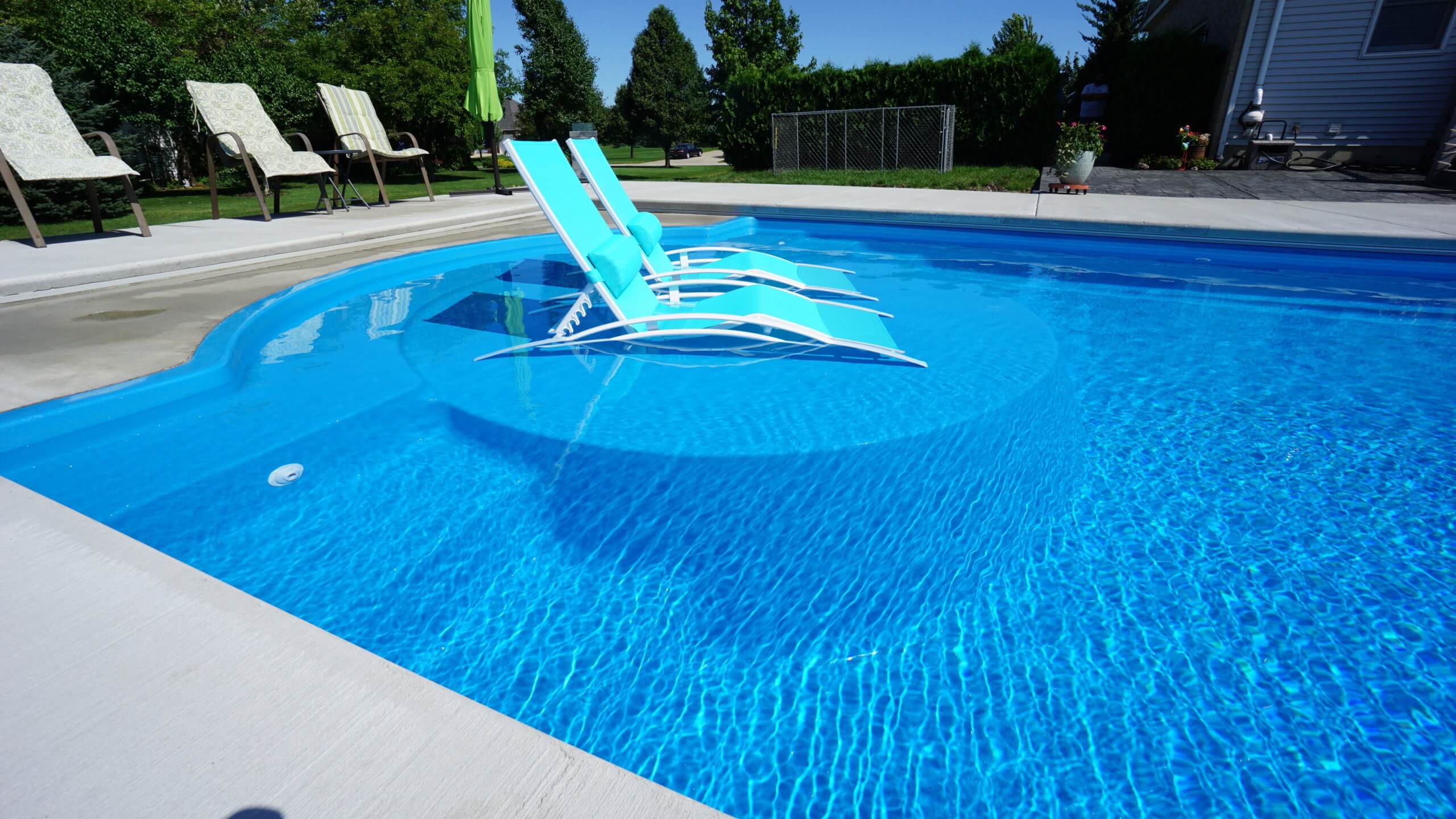
The Lowdown on Tanning Ledges
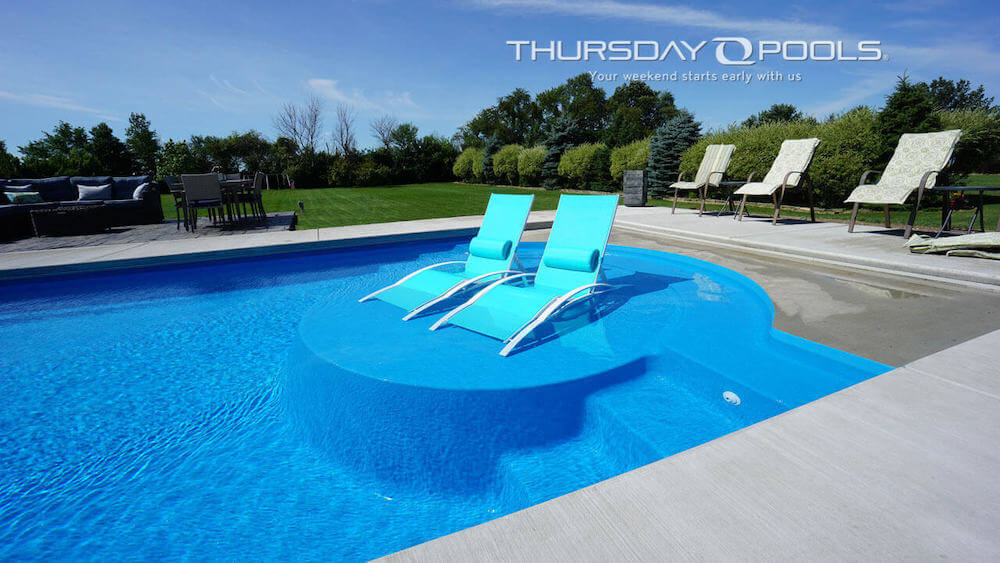
If you’ve been researching fiberglass pools or have spent time in one lately, you might have discovered the beauty and versatility of a pool tanning ledge. The tanning ledge is a feature, usually as wide as the pool or about nine feet in diameter if inset, that pulls the deck experience and pool experience together. Rather than going back and forth between a deck chair or lounger, you can bring the lounger into the pool! This post will answer the most common questions about pool tanning ledges.
What is a tanning ledge, and why would I want one?
Tanning ledges are an elevated pool bottom for easy entry or lounging. The depth is about 18 inches from the lip, and the water depth is typically around nine inches but can range between six and eight. It’s deep enough that you can cool off but shallow enough that you can place a chaise lounger on it, and it won’t float away. In addition to the feeling of luxury that comes with stretching out and relaxing on the tanning ledge, the feature provides easier entry and exit for parents with toddlers, people with pets, or elderly swimmers.
Tanning ledges offer pool-goers of all ages the best of both worlds. For small kids, they are the perfect spot for them to play and still stay well within your sight. For older kids and adults, they’re great for staying cool while relaxing in the sun. Additionally, they’re great for old guys and gals (and pets) to get in and out of the water without navigating many steps.
What are some other names for tanning ledges?
Have you ever been down south, someone offers you a Coke, you say “yes,” and then they ask, “what kind?” The same way you may ask for a “coke”, “pop”, or “soda” differently depending on where you are, the tanning ledge has its own regionally accepted names.

Are tanning ledges the same for all pool types?
No, you’ll want to consider several factors if a tanning ledge is a feature you want in your pool. When considering a pool tanning ledge, cost, appearance, safety, durability, comfort, and maintenance may influence your pool type choice. While we are fiberglass pool manufacturers, we have a broad perspective based on conversations and working over the years with homeowners, installers, and the innovators in our manufacturing facility. Here is a quick guide to tanning ledge options for vinyl liner pools, gunite pools, and fiberglass pools to help you decide the best pool for you.
Vinyl liner pools
Today’s vinyl liner pools can offer many different configurations with ledges, steps, corner seats, benches, and wading depths that at one time were thought to be impossible. So, if you feel like a vinyl liner pool is for you, a tanning ledge is possible. Here are some factors you may need to consider::
- Durability. Often a sunbather’s favorite part of a tanning ledge is the ability to put a tanning ledge chair or ledge lounging chair on it for maximum water-to-sun relaxation potential. There is a possibility for furniture to puncture or tear the liner, so keep that in mind as you consider your options. Safety. Another concern with a tanning ledge on a vinyl liner pool is vinyl’s potential to be slippery. If you’re looking for a tanning ledge as an easy landing pad for pool entry and exit, you should consider slip and fall possibilities, and this goes for all pool types. Water weight. Depth of water is crucial to hold a vinyl liner in place. The shallow water of a tanning ledge area may not carry enough weight to keep your liner in place over a tanning ledge. It can be challenging to get the corners to pull in without ballooning or wrinkling.
- Cost. Some buyers go with vinyl because of its comparably low up-front cost. Adding a feature like a ledge can negate some of those savings.
Gunite (concrete) pools
If your budget is unlimited, then the sky’s the limit for how you can configure the shape and size of your tanning ledge on a gunite pool. Gunite pools are entirely customizable. If you feel like gunite is the pool for you, here are some things to think about when it comes to installing a tanning ledge in a gunite pool:
- Expense. Gunite pools are incredibly durable, so there’s very little chance of damaging the pool surface with ledge loungers. However, gunite pools can be expensive in the Midwest and may exceed the budget for many homeowners.
- Maintenance. There can sometimes be problems with plaster finishes, and in climates that require winterization, the tanning ledges should be tiled or painted (so make sure you consider that when you’re planning).
- Surface comfort. You may not have to worry about slipping if the ledge is textured. However, a textured finish could be rough on your feet or your pet’s paws. It can also cause snags on swimsuits for those who sit on the ledge itself.
Fiberglass pools
A fiberglass pool with a tanning ledge may be your best bet. Fiberglass pools have come a long way over the years and now come in many sizes and configurations that include tanning ledges. Here are some things to know about them:
- Low-maintenance durability. Thursday Pools fiberglass pools with tanning ledges are structurally very sound thanks to our innovations in fiberglass pool manufacturing.
- Affordability. Particularly in the Midwest, a fiberglass pool with a tanning ledge may be less expensive than a custom gunite pool.
- Non-slip (and still gentle on feet and paws). The surface of a fiberglass pool is a non-skid gel coat finish that’s the ideal combination of beauty, durability, and smoothness. Of course, everyone needs to be careful when entering and exiting the pool, but fiberglass offers comfort and safety combined.
Are design options limited for a fiberglass pool with a tanning ledge?
While we have to acknowledge the near-infinite customizability of gunite pools, we also must point out that there is a fantastic array of design choices available if you’re looking at an inground fiberglass pool design with a tanning ledge. The choices include freeform pools as small as 25′ in length to a 40′-long rectangle pool with a tanning ledge. Another fun design option, a Wet Deck, has a tanning ledge as a stand-alone complement to your pool. The deck can feature design elements like rocks, tiles, waterfalls, or spillovers.
Thursday Pools Tanning Ledge Options
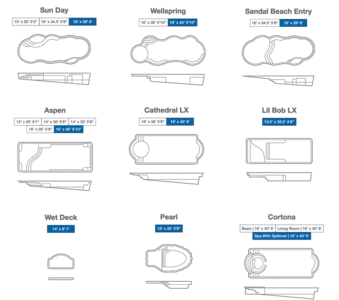
The more you investigate tanning ledges, the more seriously you might be considering one in the pool you select. We don’t blame you! It’s the perfect luxury-style feature for a fiberglass pool that offers durability, affordability, and safety. Let us connect you with a pool dealer near you.
Everything You Need to Know About Inground Pools: Comparing Fiberglass, Vinyl, and Gunite Options
Double-O7 Skimmer®
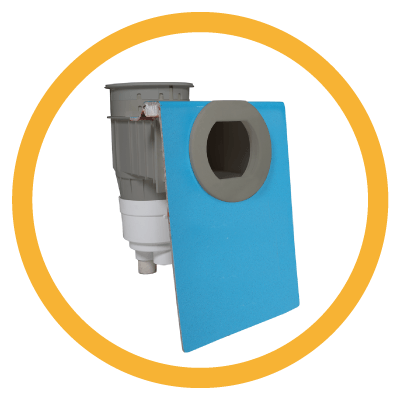
Skimmers® Exclusively for Fiberglass
Thursday Pools has two skimmers specifically designed for the unique aspects of fiberglass pools. They are the first skimmers designed with a 7° angle and special mounting plate to provide a more polished look after installation. Not only do our skimmers look better, but they’re easier for your dealer to install.
Skimmer Features
7° angle for easy installation. Our skimmers are manufactured to account for the five to tenth degree draft angle most fiberglass pool manufacturers use. The angled skimmer reduces the number of extension collars required to level the skimmer, makes for an easier installation, and allows the pool to reach its optimum water level.
Mounting Plate. The lip over the opening on a traditional skimmer’s mounting plate is not wide enough to cover the thickness of fiberglass pools. The Lucky 7 and Double-O7 Skimmers’ lip extends farther to ensure the raw fiberglass pool edge is not exposed, providing a more finished look.
The Double-O7 Skimmer® (US Patent 10,961,736) adds a few additional benefits to your pool.
- Easily allows for maximum skimmer height and position.
- The sleek design matches LED lights, returns, bubblers, and other round features of your pool.
- A simple 6 7/8” standard circular hole cut helps with easy installation.
Please note: the Double-O7 Skimmer® is an option on all of our fiberglass pool designs; however, it does not come standard on any of them.
Pool Specifications
Ask the General: Can Decorative Concrete Inlays Improve the Look and Feel of our Inground Pool?

Dear General,
Our fiberglass pool looks great, but we’re starting to see some significant wear and tear to the surrounding concrete. Frankly, we’re envious of all the new pool designs available on the market today, and we want to up the wow factor of our backyard. After some initial research, decorative concrete inlays look like a viable solution. What do you recommend?
Sincerely,
Soaking in Savannah

Dear Savannah,
Thanks for helping me understand where you’re coming from. Many pool owners find themselves in your situation as time passes, and most, like you, take pride in keeping their backyard fresh and updated.
An aging concrete patio and pool surround can really take away from the elegant look and feel of your backyard and simply make it less inviting. In the past, I’ve seen pool owners attempt to cover up aging concrete a couple of ways.
- The old patch, fill, pressure wash, and paint it method. Some pool owners resort to patching holes, filling cracks, pressure washing stains, and then using deck paint to make it look a bit more fresh. It looks great about half of the season, then you realize it’s going to need to be repainted every year.
- The hide it, nobody goes over there anyway method. Other pool owners attempt to fix up the area on the side of the house where everyone spends most of their time, hoping they won’t see the ugly concrete in another. Or perhaps, they cover it with indoor/outdoor carpet. When that wears out, they might even try to build a deck over it.
Decorative Concrete Inlays are a more permanent solution to repair the old concrete deck surrounding your fiberglass pool.
Decorative concrete inlays are made of a polymer-modified cement that is applied over the existing concrete deck. My deck was probably ten years old and really showing age when I had it overlaid. I hired professionals to do the work, and they came in and patched the bad places, filled the cracks, and ground down some rough edges. The process only took a few days from start to finish. It looked fantastic, and 20 years later, it still does. You will need to reseal it every five years, but all that involves is a bucket of their sealer, a paint roller, and forced labor of one of your kids or grandkids. It is amazingly easy to rejuvenate the whole area by doing this simple task.
Speaking of cracks, I must admit that some of the original breaks returned because the concrete under the coating had structural cracks. Fortunately, they were on the far side of the pool and not very noticeable. One thing that I have noticed is that the coating is slicker and smoother than regular concrete, especially when wet. So, no running around the pool. There are anti-slip materials that can be incorporated if desired. The best thing is that it’s a great way to get your pool deck back in shape and make you less envious of all those new pool designs you mentioned.
To help you with your decision, here are some answers to frequently asked questions I have received on this subject:
How long is the lifespan of decorative concrete inlays?
If maintained and resealed properly, it will last 20 years and beyond.
How thick are decorative concrete inlays?
It is applied approximately 1/8 inch thick. However, some applications may be thicker depending on the design, and whether the installation is interior or exterior. In case you’re wondering, it is not a toe stub, trip hazard.
How do I clean it?
Light pressure washing is the best way to clean concrete; however, Simple Green, or even Windex, is excellent for spot cleaning stains. Just be sure to rinse thoroughly with a garden hose.
Can it be used on new concrete?
Yes, once the concrete is completely cured, the coating may be applied.
How is it priced?
It is priced on either linear foot, square foot, or both. There are many variables, such as decorative inlays, such as logos, sundials, printing, or any custom design you desire.
Can multiple colors be used?
Yes, within reason. Some darker colors are very uncomfortable to walk on in direct sunlight.
Why is decorative inlay sometimes referred to as Kool Deck?
Invented by Mortex in the early 1960s, Kool Deck is the brand name that was the first of its kind for decorative concrete inlays. The lighter colors the brand offered were much cooler to walk on barefooted than regular concrete.
In the beginning, some applications would chip up, but those were water-based. Be sure that your installer is using a polymer-based system.
In my experience, there have been many instances where we coated concrete rather than tore it out. Whether it was ruined by rain, hail damage, flood staining, you name it, back then, it was Kool Deck to the rescue. We were very fortunate to have professionals working alongside us to handle this aspect of the job. R&D Resurfacing in Indianapolis, IN, was a solid partner for us, and their experience always impressed me.
Well, Savannah, I hope this gives you some perspective. As for me, it’s time to pump water off the winter cover, AND ADD WATER UNDERNEATH.
Have a great spring!
The General
Ask the General: What is a Pool Heat Pump and How Does it Work?
Dear General,
I have a question about how to heat our new pool. We want to keep our pool maintenance costs as low as we can, but it’s important for us to be able to swim as much as possible during the year, so we want it to be warm! A couple of my friends with inground pools have gas heaters, but several people have told me I should consider a pool heat pump. I’m not sure how either of them work. What’s my best option?
-Chilling in Charleston
Dear Charleston,
Thanks for the great question! You’re not the only person who’s feeling a little fuzzy on this topic. Let’s first take a look at the difference between how these two types of pool heating systems work.
The difference between a pool heater and a pool heat pump
- Traditional pool heaters use either propane or natural gas to generate heat. They do so by burning the fuel inside a combustion chamber. The pool water is drawn through the heater in copper coils, which warm it. Then, that warm water is returned to the pool. You can set the thermostat to whatever temperature you desire, and the heater will bring your water up to that temp pretty quickly.
- Heat pumps (also known as electric pool heaters) are, as they say, a whole ‘nother talk show. The big difference is that they don’t actually generate heat on their own. Instead, they pull ambient heat from the air around your pool and use that heat to warm your pool water.
How does a pool heat pump work?
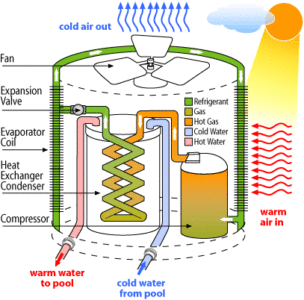
Next, let’s look more in depth into how heat pumps work. The following information is taken from the National Pool and Spa Institute’s technology class:
- Thermostat. First, you’ll set the thermostat on your heat pump to your desired water temperature. Then, it gets to work.
- Fan assembly. The fan assembly starts the process by pulling warm, outside air into the evaporator coil.
- Evaporator coil. Liquid refrigerant inside the evaporator coil gathers heat from the warm air and transforms it into gas.
- Compressor. The warm gas in the evaporator coil is then pulled back into the compressor, which increases the heat.
- Heat exchanger. This heated gas then passes through the heat exchanger condenser.
- Pool pump. While all this is happening, your pool pump is busy circulating your cool pool water, so it will eventually pass through your heat pump’s heat exchanger.
- The magic happens. As the heated gas and your pool water pass through the heat exchanger at the same time, the gas transfers its heat to the water. That nice, warm water flows back into your pool, the hot gas returns to liquid form and goes back to the evaporator, where the whole process starts over again.
Is it a lot of work to have a pool heat pump?
When purchasing any pool equipment, you of course want to know how much work it will be for you to maintain and if it’s safe for your family. Fortunately, all you’ll need to do to maintain your heat pump is keep the surrounding area clear, the water flow normal, and chemical levels correct. The following features of a heat pump make them essentially hassle and worry-free for pool owners:
- Pressure switch. Just like other types of heaters, heat pumps have a pressure switch that allows the heat pump to run only with the correct amount of water flow. This ensures that heat will be removed by enough water inside the heat exchanger to prevent overheating and damage to the unit.
- Low-ambient switch. This switch allows the heat pump to run only when the surrounding air temperature is high enough to prevent damage to the compressor. Wet bulb controllers allow the heat pump to run in temperatures as low as 30 degrees. However most units are factory-set to only let the unit operate at 45 degrees or higher.
- Refrigerant low-pressure switch. This control prevents compressor damage from loss of refrigerant. Since refrigerant temperature and pressure are related, this switch also backs up the low-ambient switch to prevent the unit from running too cold.
- Refrigerant high-pressure switch. This control protects the compressor from operating with too-high refrigerant pressure, which would contain too much heat. It also backs up the water pressure switch, which in turn prevents the unit from overheating.
- Built-in water bypass. Some heat pumps also have a built-in water bypass feature, which prevents too much water from entering the heat exchanger, which could cause excessive wear on the metal and shorten the life of the heat pump.
- Time delay. This control prevents the restart of the heat pump after electrical power has been interrupted. Time delays are set for 3 to 10 minutes. The time delay is necessary for the refrigerant pressure to equalize from high side to low side.
Is a pool heat pump the right choice for you?
It depends. Obviously, if the ambient air isn’t warm (at least 50 degrees,) there’s no heat source for your heat pump, and your pool water won’t warm up. Since you live in Charleston, where it’s typically pretty warm year ‘round, it’s probably a good choice for you, and will help you reduce your pool operating costs. Folks who live in cooler climates are probably better off with a traditional gas-powered heater.
Tips to keep the most from your pool heating system
- Set it and forget it. If you want to reduce your pool operating costs, it’s better to maintain the water temperature at or near your desired temperature, regardless of what kind of pool heating system you have. Find your desired temperature and leave the thermostat alone. If you turn it off, and the night gets cool, it can take several days to get your water back to the temperature you want.
- Get an automatic pool cover. I’ve written articles about automatic pool covers before. I’m a big fan. While fiberglass pools are actually the best type of pool for retaining heat, a pool cover will do even more. Not only will it help keep that precious heat inside the pool, it will also keep debris, kids and critters out.
So, there you go, my friend … Everything I can think of to tell you about heat pumps, all in one place. Best wishes to you and your family on your new fiberglass pool. You’re going to love it.
Until next time…
-The General
Who is The General?
The man, the myth, the legend….we just call him The General. His organized, systematic approach to pool installations over the years had his crew members calling him “The General” and it stuck. The General has over 30 years’ experience in the pool and spa industry, working for one of Pool and Spa News’ “Top 50 Pool Builders.”
Over that time, he designed, sold, project-managed and installed over a thousand inground swimming pools. As a pool owner himself, he’s the perfect authority to give you the inside scoop, with amazing tips and tricks to make pool ownership a breeze!
Six Tips for Swimming in Style with the Best Pool Lights
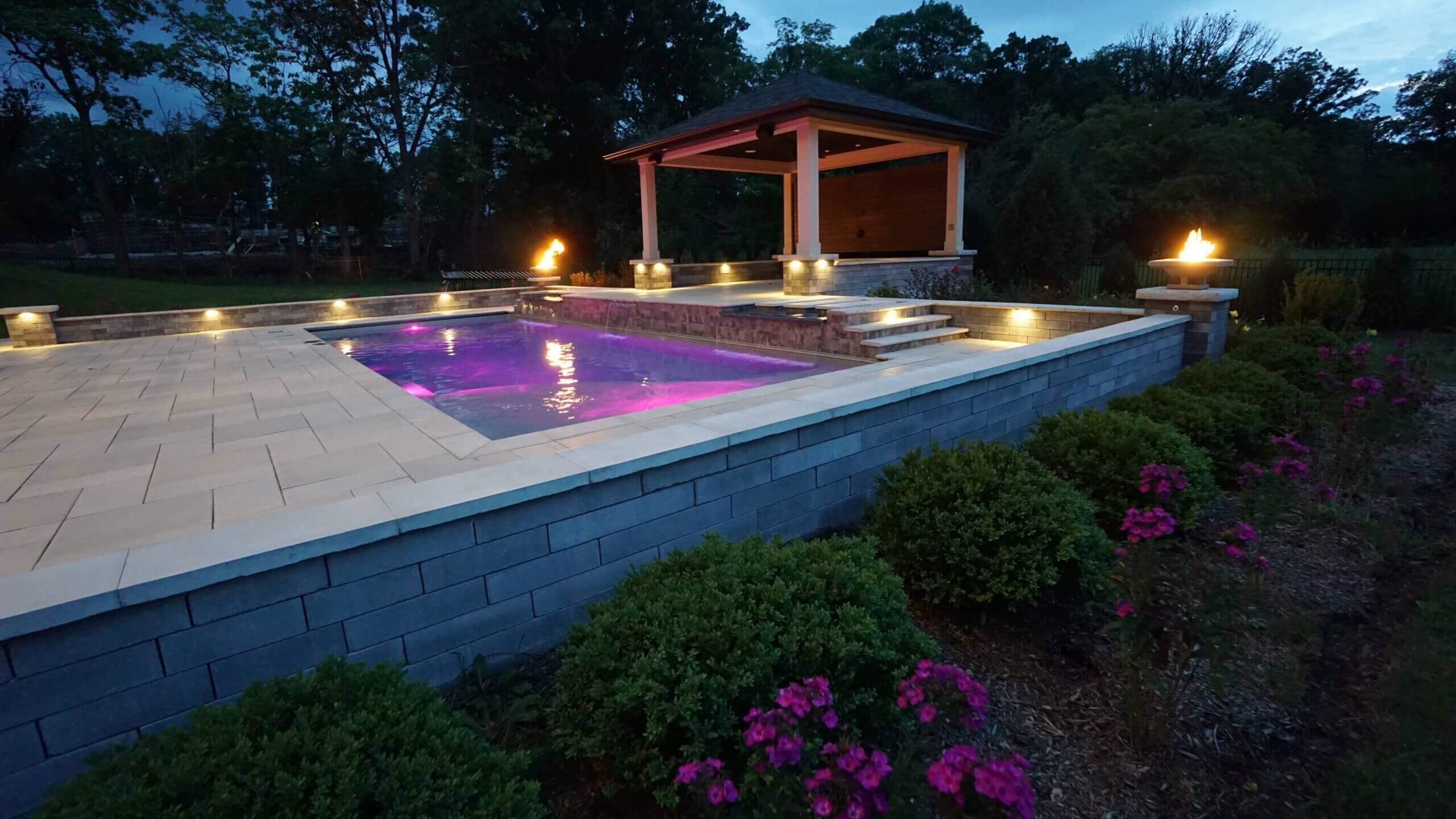
As you’re planning your new inground swimming pool project or adding enhancements to the fiberglass pool of your dreams, don’t forget to consider the important role pool lights can play — the glow can not only make your oasis safe, but illuminated in a style all your own. There was a time when even the best inground pool lights came with just two options: on or off. Those days are long gone! From efficient LED pool lights to luxurious spa lights, a multitude of possibilities for underwater pool lights or even above-ground pool deck and area lighting, check out these six pool lighting tips and ideas to add both style and safety to your backyard.
LED Pool Lights Have Changed the Pool-Lighting Game
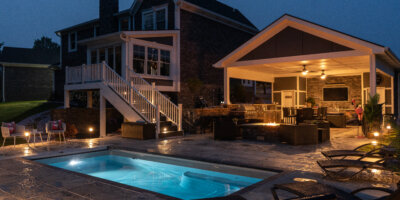
LED lighting accounts for the most significant and impactful improvements in swimming pool lighting throughout the past decade. They bring versatile options to the world of inground pool lighting, and, as an additional benefit, they’re energy-efficient with a longer lifespan than incandescent bulbs—helping you save money on long-term pool maintenance costs.
Let’s explore six dazzling pool lighting trends and ideas that will make your backyard oasis unique and your pool parties shine:
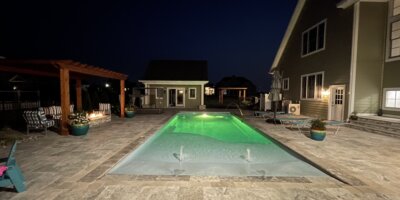
- Color Your World: Color-changing LED pool lighting allows you to set the mood for any evening around the pool. If you’re planning a beach-themed party, consider all blue hues of LED lighting. Or a constantly changing rainbow effect will pair perfectly with your 1970s-themed disco extravaganza. Choose luxurious all-white lighting if you’re planning a sophisticated evening or even a poolside wedding.
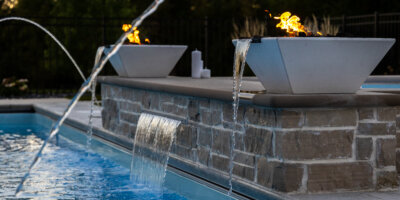
- Highlight Your Water Features: Spa, plunge-pool, and in-pool water features such as bubblers, jets, and fountains can help create different moods in your pool environment. They’ll give younger swimmers hours of splish-splashing fun, but can also be relaxing or amp up the drama for a special party. Highlighting those water features with specialty lighting can add to your backyard’s overall “WOW” factor.
- Uplight Your Landscaping: If you’ve invested in beautiful landscaping surrounding your pool area, make sure it can be seen and appreciated at all hours. Adding uplighting around the bases of trees, bushes, or shrubs creates a warm and elegant mood after the sun goes down.
- Light Your Path for Safety: Swimming pool safety is paramount, especially during the evening and after-dark swim sessions. In addition to in-pool lighting options, consider installing recessed lighting throughout your pool deck and along the pathways leading to and around your pool. With recessed lighting options, you won’t have to worry about tripping or stubbed toes as you move to and from the pool area.
- Get Creative with Floating Pool Lights: A fantastic variety of fun, festive, free-floating pool lighting options are available today. They even come with built-in speakers or color-changing capabilities in a wide range of styles to perfectly complement any backyard or poolside celebration. From flameless candles and lanterns to glowing orbs, globes, and lily pads, you can find countless battery-powered lighting and floating options that you can enjoy time after time.

- Add the Nearby Glow of a Warm Fire: While a more extensive landscaping and design project than floating lights or LED options in and around the pool, there’s nothing quite like a fire’s cozy glow and warmth to enhance your outdoor living space. Fire pits, tables, or other fire features can be installed in your patio space close to your house, on pedestals around the edges of the pool area, or immediately adjacent to the pool so you can go straight from swimming to s’mores any time.
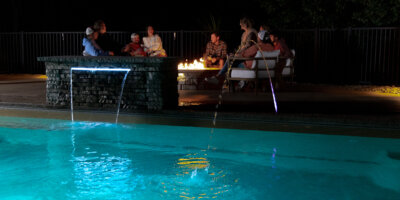
You’re only limited by your imagination when it comes to exciting, illuminating ideas for lighting your swimming pool! So as you’re planning for your new inground fiberglass pool oasis, consult with your project’s builder and installer about the possibilities and lighting options you can include to make your pool safe, well-lit, and uniquely yours.
Cool Pool Patio Options for Your Fiberglass Pool
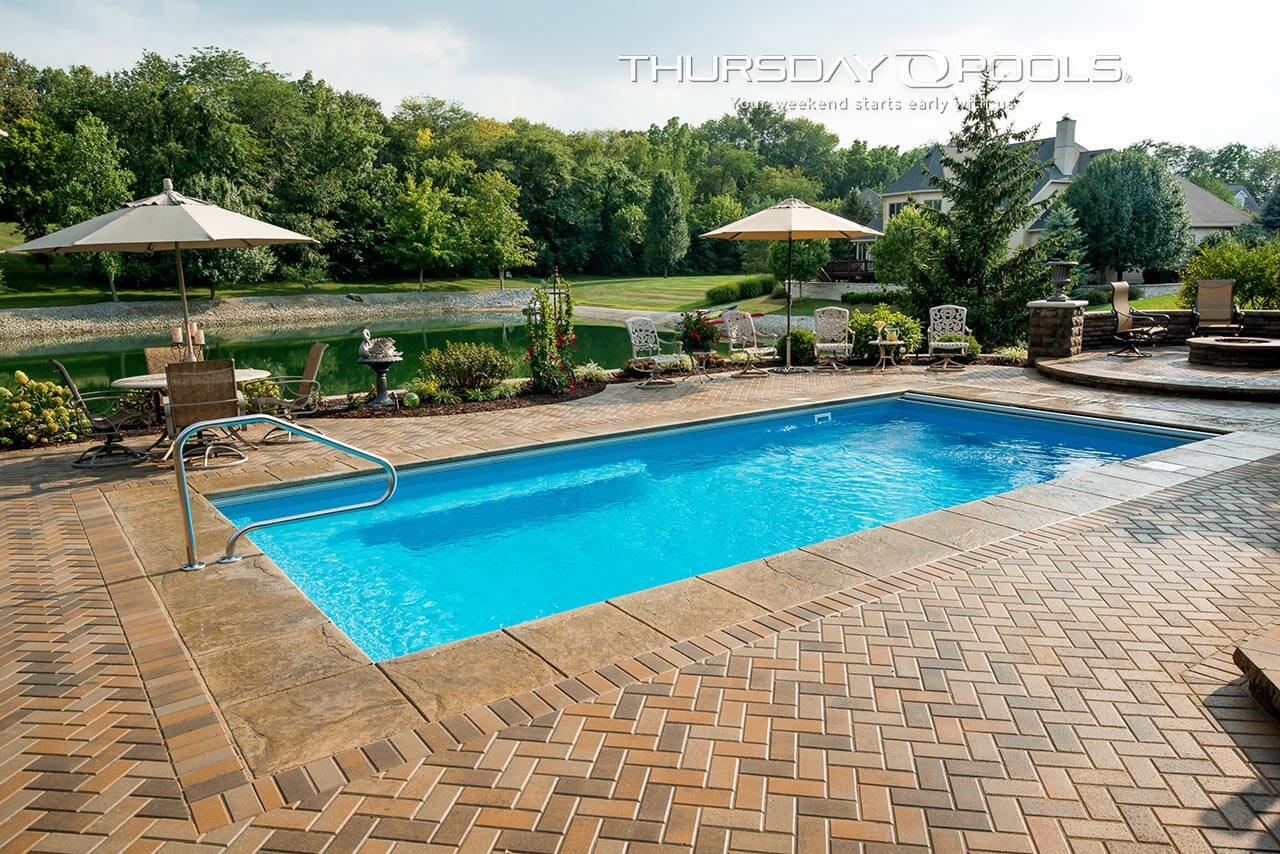
When you’re first thinking about a new fiberglass swimming pool, you’re probably thinking about the pool itself— how much does a fiberglass pool cost? Should you choose a rectangular design or a freeform? A big pool or a small pool? Once you’ve made all the pool design decisions, it’s time to start thinking about how you’ll finish it all off. Your pool patio will become the heart of your outdoor space, setting the stage for everything from relaxing summer days to lively gatherings.
Is Any Patio Included in the Pool Installation?
As part of the installation quote, many pool builders include 3 to 4 feet of standard concrete patio around your pool. This basic patio can be a good starting point, allowing for some furniture, but you should leave a minimum of 3-foot width for pathways and traffic areas. If you plan on entertaining a lot or have a larger family, you may want to invest in a bigger patio space. Some builders offer patio upgrades directly, while others may recommend a landscape designer. Regardless of who installs it, there’s a pool patio option for almost any lifestyle and aesthetic.
Classic Concrete – Affordable, Simple, and Customizable
Concrete is often the most budget-friendly patio choice, making it a top pick for homeowners who want a durable surface without breaking the bank. They are straightforward to install and provide a minimalist aesthetic that appeals to many. However, if you want to add a touch of personalization to this standard look, consider adding a decorative border around the pool. A 10- to 14-inch border with stamped concrete, pavers, or brick can create a polished and unique look that enhances the overall design. When selecting concrete, ask your contractor if they’re experienced with pool decks. Pouring a concrete patio around the edges of a fiberglass pool requires precision, and an experienced hand will ensure a flawless finish.
Stamped and Colored Concrete – A Plethora of Patterns and Hues
Gone are the days when concrete only came in basic gray. Today, you can choose from many colors to complement your backyard’s aesthetic—beige, brick red, slate blue, or even custom shades to match your home’s exterior. With stamping techniques, concrete can mimic traditional materials like brick, slate, flagstone, tile, and even wood, giving your pool area a high-end look for a fraction of the cost.
You might choose a slate or flagstone pattern in rich, earthy colors for a classic Mediterranean-inspired design. If you prefer a more modern look, geometric stamping in cooler shades like grays or blues might be your style. A Roman-shaped fiberglass pool, for instance, looks stunning with a complementary flagstone-stamped concrete finish.
Exposed Aggregate – Natural Texture with Visual Appeal
Exposed aggregate is an excellent choice for a truly unique texture and aesthetic. The process involves removing the top layer of cement to reveal the underlying stones, resulting in a durable, slip-resistant, and visually striking surface. The exposed rocks create a natural, riverbed-like effect that is perfect for a rustic or organic design in your backyard.
This patio type fits beautifully around freeform fiberglass pools, especially if you want to create a more relaxed, natural space. The finish also pairs well with lush landscaping and other organic elements, giving your pool area the feel of a natural oasis.
Pavers – Versatile and Stylish for Endless Design Possibilities
For homeowners looking to add both texture and color, pavers are an excellent choice. Pool deck pavers come in various colors, materials, and styles, so you can mix and match shapes and colors to achieve a one-of-a-kind look. Pavers also offer the benefit of easy repairs; if a section is damaged, you can replace individual pavers without having to redo the entire patio.
Patio pavers are durable and can be arranged in different patterns, such as herringbone, basket weave, or a simple staggered design, to create a visually appealing look. For rectangular pools, pavers in neat, geometric patterns create a sophisticated look, while freeform pools pair well with more organic, irregular shapes that blend seamlessly with the pool’s curves.
Natural Stone – Timeless Beauty and Enduring Strength
For unmatched beauty and elegance, choose natural stone like flagstone that is highly durable and adds a touch of class to any poolside area. Natural stone is also slip-resistant and maintains a comfortable temperature in hot weather, making it ideal for pool areas where comfort and safety are essential. Natural stone pairs especially well with freeform pools, as its irregular shapes and textures bring an organic feel to the space. Consider combining it with lush greenery or even a small water feature for a resort-like feel to create a relaxing, spa-like poolside retreat.
The Finishing Touch to Your Backyard Oasis
A well-designed pool patio brings out the best in your fiberglass pool, blending form and function to create an inviting outdoor living area. Whether you opt for budget-friendly concrete, artistic stamped patterns, or the elegance of natural stone, your pool patio will become the hub of relaxation and fun and set the scene for countless memories. Once you have a few patio ideas in mind, consult with your pool builder or contractor about the specifics of your backyard space.