What’s So Great About a Fiberglass Pool?

fiberglass pool advantages

Fiberglass Pool Advantages & Benefits

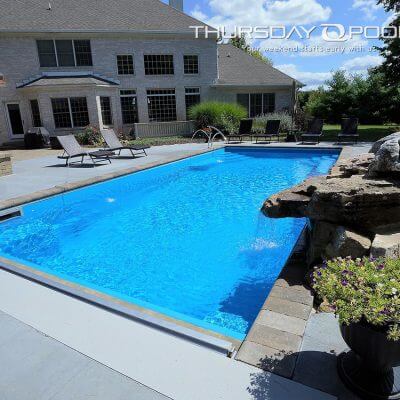
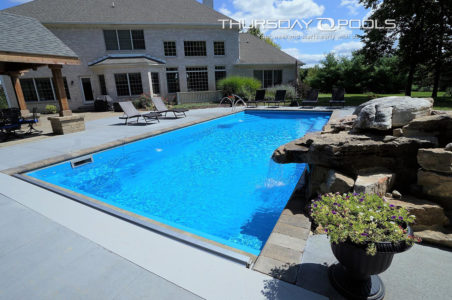
When you’re thinking of buying a pool, there’s a lot to consider. The first thing you’ll have to decide is whether you want fiberglass, concrete or vinyl. Personally, we believe that fiberglass is the way to go and that there are many fiberglass pool advantages. What’s so great about a fiberglass pool? Read on to learn!  

  1. That Gel Coat Finish. Why is it so great? First of all, it’s nonporous, and what that means to you is that it’s harder for algae to grow, which reduces the amount of sanitizing chemicals you’ll need (said another way, it saves you money!) The gel coat is also smooth to the touch– no scraping your little tootsies on a rough pool bottom. And because the gel coat finish is so durable, your furry kids can also get in the swim without you having to worry about damage.
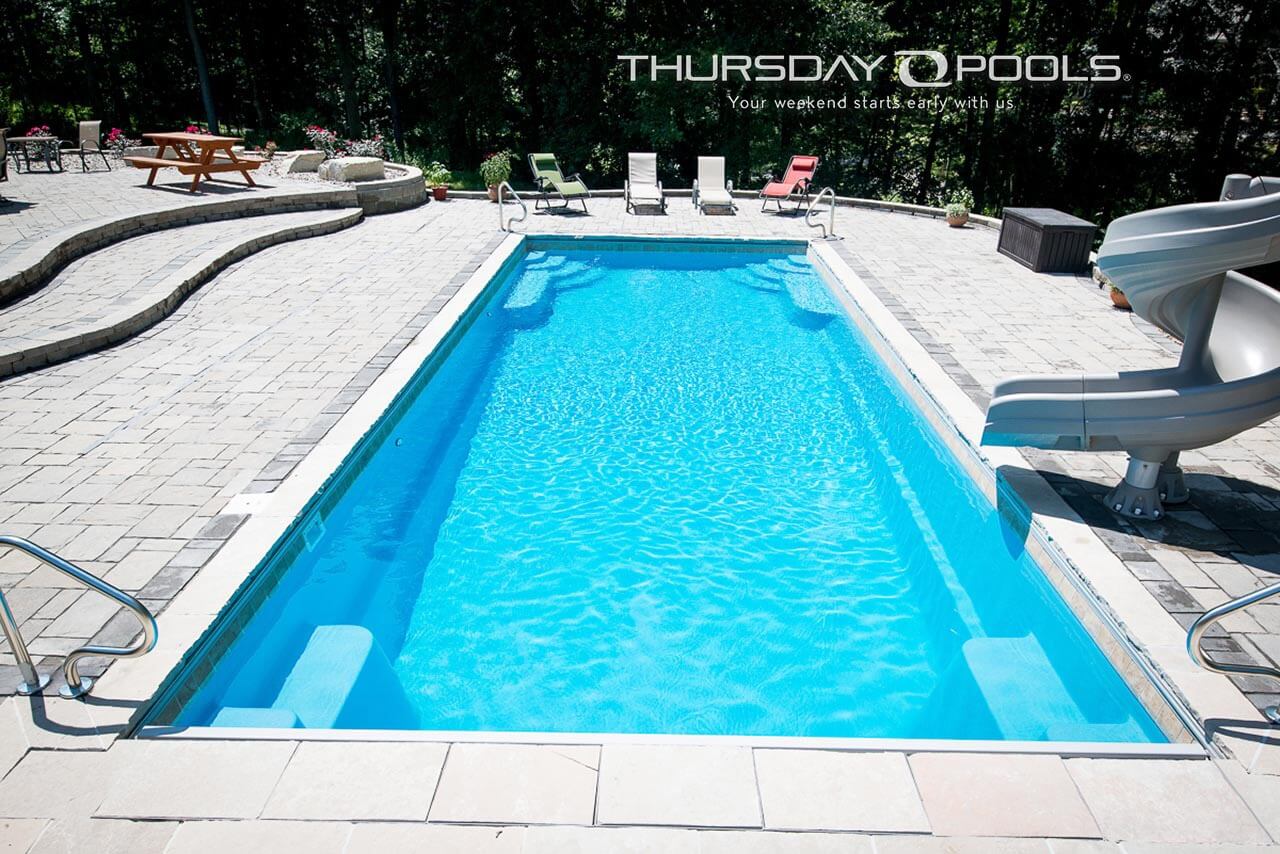
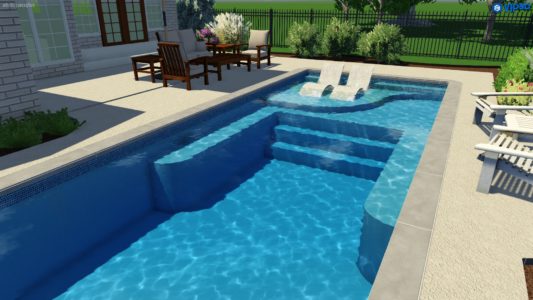
  2. Built-in Seats, Steps and Tanning Ledges. Unless you’re planning on training for the Olympics, you’ll probably want to do more than just swim in your new pool. Fiberglass pools have wonderful built-in benches for sitting and chatting, tanning ledges and sun shelves for keeping cool while you’re soaking up some rays, and easy to navigate steps for graceful entrances and exits from the pool– those backwards ladders aren’t doing anyone any favors, and not everyone has the upper body strength to hoist themselves over the edge– we sure don’t!
  3. One-time Investment. With vinyl liners, you’re always going to worry about ripping the liner. With concrete, you have to worry about cracks, crumbling and resurfacing. With fiberglass, it’s one and done! You won’t have to worry about replacing a liner that the kids (or the dog!) has ripped and you also won’t have to repair concrete that cracked over the long, cold winter. With all types of pools, the life expectancy of your pool’s surface is greatly determined by how well you maintain proper water balance. Harsh water conditions can affect all pool surfaces and equipment.
  4. Quick Installation. Fiberglass pools arrive at your door ready to install. They’ve been built in a shiny clean manufacturing facility and they’re made just for you, to your specifications. Your pool installers can just drop them in and get you swimming much faster than building a concrete pool, which can take up to six months to build.
  5. Beautiful shapes, sizes and colors. Fiberglass pools come in an amazing array of shapes and sizes, so you can get as creative as you want to be when it comes to creating your perfect backyard oasis, and get just the right features for the way your family wants to use the pool. They also come in several different finish colors, so whether you want a Caribbean blue, calming green or sophisticated gray, there’s a color to fit your style.

With so many advantages to owning a fiberglass pool and so many options to choose from, the question becomes– what are you waiting for? Check out our fabulous selection of fiberglass pool designs today and get swimming by the Spring!

Ways to Heat Your Swimming Pool

It gets cold in North America, even in our most tropical climates. Depending on where you live, nighttime cooling or winter weather can interfere with an enjoyable swim. That’s why before purchasing, buyers commonly ask, “can a fiberglass pool be heated?” The answer is yes: like other inground pools, you can heat a fiberglass pool. In fact, they tend to heat faster and retain heat longer than other pool types. Let’s explore the options for heating a pool. 


Gas Pool Heaters

Gas heaters are relatively more cost effective upfront, but can be expensive to operate. While  gas pool heaters will heat your pool quickly and are durable in inclement weather, they wear out faster than other pool heating options. They are an ideal option if heating your pool as quickly as possible is an important feature. 


Gas heaters run approximately $1,500 to $6,000 for a typical residential inground swimming pool on average, and installation typically costs another $500 to $1,500. Operating the heater may run around $200 to $400 per month, depending on how frequently you run it and the utility prices in your area.


Gas Heater Pros: heats up fast 

Gas Heater Cons: more expensive to run and don’t last as long


Propane Pool Heaters
If your home doesn’t have a natural gas supply line and you still want a gas heater, a propane pool heater is an alternative. Propane works much like gas. It reliably and quickly heats the pool water and is relatively easy to hook up. Propane units can wear out quicker than other options and, like gas units, cost a little more to operate. 


Like natural gas, propane pool heaters run between $1,500 and $6,000 and $500 to $1500 to install on average. Operating a propane heater typically costs around $200 to $850 per month, depending on the frequency of usage and propane prices in your area.


Propane Heater Pros: heats up fast and efficiently

Propane Heater Cons: more expensive to run and don’t last as long
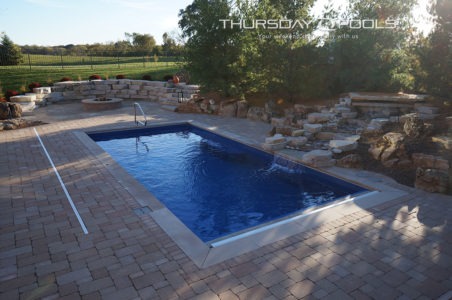
 

Electric Heat Pump Pool Heaters

Heat pumps are becoming a popular option for pool owners as they are an energy-efficient means of heating a pool. They use a 220V electrical line to convert energy into heat. Heat pump pool heaters work most efficiently when the outside temperature remains above 45 to 50ºF. 


A heat pump’s mid-range price is around $3,500, and installation costs between $500 and $1000 on average. However, they typically only cost about $120 to $200 per month to operate. Because electric heat pumps work off the ambient air temperature, they are slower to heat than a typical gas heater. 


Heat Pump Pros: less expensive to operate, energy-efficient, a cleaner energy source

Heat Pump Cons: slower to heat, dependent on outdoor temperature, more expensive upfront


Electric Resistance Heaters
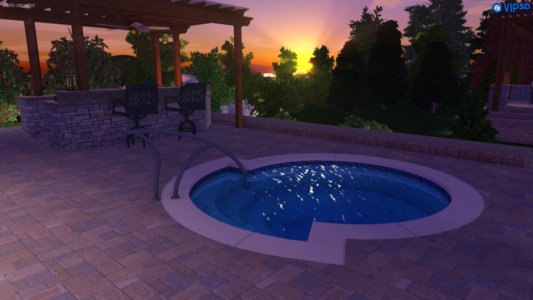
Like electric heat pumps, electric resistance heaters run on electricity. However, instead of relying on ambient air temperature, the pump passes water directly over a heating unit, resulting in efficient water heating despite the outdoor temperature.


Electric heaters cost an average of $500 to $5,000 plus installation costs around $500 to $1000. Operating costs depend on usage and utility prices but are typically higher than other heating options. Expect to spend roughly $175 to $600 per month on operating costs.


Electric Resistance Heater Pros: lower upfront costs, greener energy source, not dependent on outdoor air temperature

Electric Resistance Heater Cons: high operation costs, not as energy-efficient
 

Solar Pool Heaters

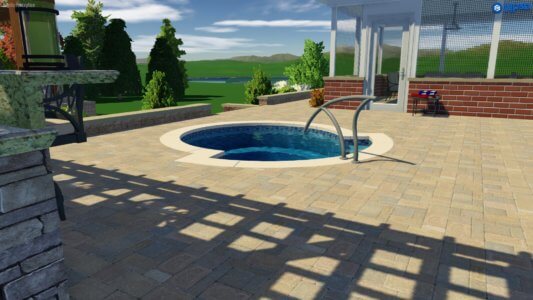
Through solar panels, solar pool heaters convert energy from the sun into heat for the pool. Solar pool heaters are good for the environment as they generate and utilize clean, renewable, and reliable energy, and they can potentially last up to 30 years with minimal maintenance. Solar heat helps eliminate carbon dioxide and nitrogen oxides emissions, a significant contributor to smog and global climate change.


Solar pool heaters are more expensive at a purchase cost of between $2,000 and $7,500 as an initial investment on average, plus an average of $500 to $2,000 for installation. They often pay for themselves over time because they have essentially no operating costs. 


Solar Heater Pros: no operating costs, long-lasting, green energy source

Solar Heater Cons: higher initial cost, slower to heat, require year-round sunlight


Location Factors

Location can factor into your choice of pool heater in several ways. By connecting with an experienced local installer, you’ll have a guide regarding these potential location factors: 

  • Tax Breaks – Your state or federal government may have added electric and solar heat pumps to the list of equipment that qualifies for special tax breaks. Talk to your dealer or tax advisor about these guidelines. 
  • Cold Climate – If you live in a colder climate, a gas/propane heater may be the way to go for its robust and quick performance. 
  • Remote Location – If you are in a remote area with limited access to the electric grid or municipal gas lines, propane or solar heaters may best suit your situation.  

It’s important to note that these price ranges will vary depending on many factors, like geographic location, whether or not you have a pool cover, average temperatures, etc. Pool heater installation may require municipality approval and connection to existing power/fuel sources. You’ll want to match the heat source choice to your pool’s location, water volume, and temperature desires. It’s not unheard of to do a DIY pool heater installation, but we suggest checking local regulations and considering using a pool professional. 
Style Your Backyard!

How to Improve Your Backyard Style

You’re spending most of your time dreaming about opening up your swimming pool this summer, aren’t you? We know you are ready to open your pool for the season. But is your space and environment surrounding your swimming pool ready? Your backyard style can make a big difference in your backyard pool parties.

Now is when you should be taking the time to decide on how you want to style your backyard. We know it’s hard to decide on a design for your backyard style. We want to help you think about all the ways you can achieve any style in your backyard.

Thursday Pools Aspen with Spa

In our guide, we cover four different styles; caribbean, modern, rustic cottage, and whimsical. In each style, we cover how small touches work together to achieve the style.

For a caribbean style backyard, we explain how details like plants and the furniture can turn your backyard into a beach paradise. In a more modern style backyard, we advise paying close attention to the color scheme and accent details to complete a more clean and polished look. A rustic cottage look can be reached by creating cozy outdoor living spaces with vintage looking furniture. Achieve the whimsical style with unique and different pieces of furniture and lighting that create a soft look in your backyard.

No matter what style you are going for in you backyard, our Style Your Backyard Paradise Guide can help get you started. Be creative and don’t be afraid to try something different in your backyard this summer. Make sure to follow our Pinterest page for more style inspiration.

Top 5 Features to Look for in a Fiberglass Pool

Fiberglass pool designs are packed full of fun built-in features. Each fiberglass pool design offers you different features and benefits. Here are some top features and why you might want to look for them when selecting a fiberglass pool design for your backyard swimming project.

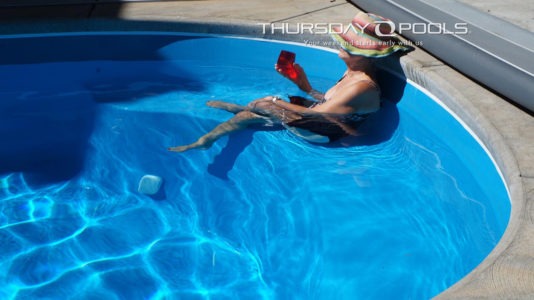
  1. Benches and Seats. In-pool benches and seats are an excellent way to enjoy your swimming pool. Benches bring a perfect conversation area into the pool. Most folks just want to chill when they hit the water; these offer a great way to do that. In fact, some of our customers have lovingly referred to them as their beverage bench. They enjoy winding down at the end of a long day with their favorite beverage in hand. Toddlers love to stand on them and waddle back and forth and try their chances at jumping into the deeper part of the pool. Benches and seats are generally down about 18”-22” from the top of the pool, so the water depth will be 14”-18”.
  2. Benches And Seats Multiple Points of Entry and Exits. Having multiple entries and exit points has several advantages. More design freedom with the pool and patio layout is one big advantage. If you can only access the pool at one corner, then that naturally limits the position that the pool can be in. Multiple entries and exits are also ideal for those who may tire quickly while swimming, like young kids and our furry friends who like to take a dip.
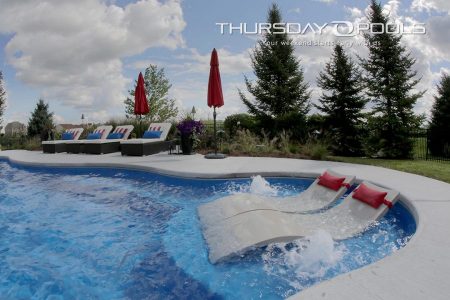
  3. Entry And Exit Points Tanning Ledge. Tanning ledges and sunshelves in fiberglass pools offer luxury living at its finest. If you are looking to bring home that resort vacation, tanning ledges are a great way to recreate that experience in your backyard. Tanning ledges can vary in depth, our standard for a tanning ledge is 12” from the top of the pool which equates to about  6”-8” of water depth. Outfit the tanning ledge with ledge loungers, and bubblers, grab your favorite beverage and enjoy!
  4. Tanning Ledges Wading Area. When you are looking for a full body submersion or a great place for toddlers to splash and play, a fiberglass pool design with a nice wading area might be a feature you want to consider. Wading areas are similar to tanning ledges but offer more water depth. Water depth of a wading area is 14”-18” of water. Take a look at our new pool designs that offer wading areas that feature both a tanning ledge and a wading area.
  5. Wading Area Swim Lane. A swim lane is an unobstructed space in the pool that can be easily used to swim laps back and forth in the pool. While you may not be looking to join the swim team, you may find that you enjoy a few vigorous strokes to exert pent up stress and energy. You will certainly fill invigorated enough once you hit the water.

Exercise in Your New Swimming Pool

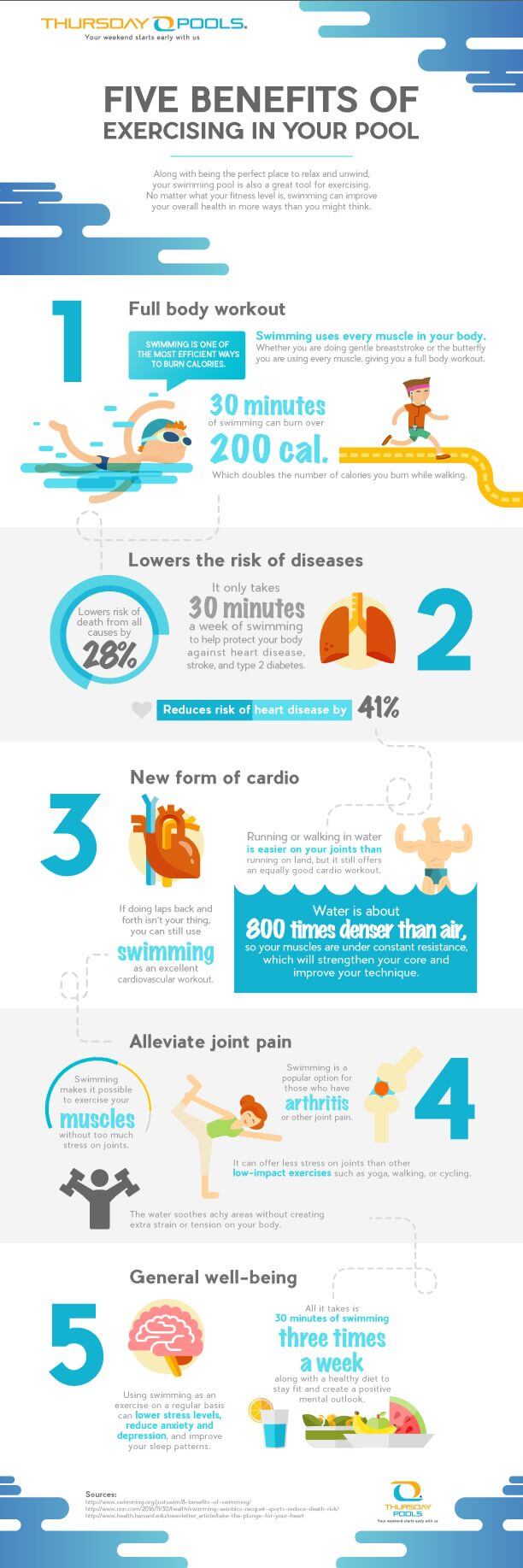
Are you still hanging on to the New Year’s Resolution bandwagon to exercise more? We have a great idea that will help you to continue your hard work into the summer and to kick your workout regimen up a notch. Adding a new swimming exercise pool to your backyard is an excellent way to keep our workouts interesting and, now this may sound crazy, but also more fun.

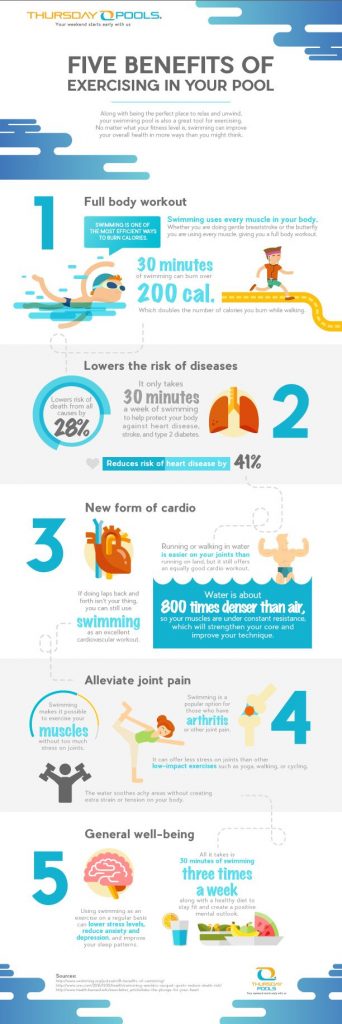
Exercising in your pool is an excellent workout for your whole body. The water offers both resistance and support, allowing you to get an intense workout without stressing out your joints. The perfect exercise pool is designed to keep the workout that appeals to you, whether that is swimming laps or water aerobics. The best part is that you can choose a pool design that fits your exercise needs and offers a perfect place to sit back and relax.

exercise poolIf you’re looking for a pool to swim laps up and down in, a pool that is at least 34 feet in length and has a depth of at least three and a half feet will accommodate those needs. Any pool of this size or larger will give you plenty of space to work on your backstroke and butterfly stroke. The Goliath and Monolith are both great options for anyone looking to swim laps in their backyard.
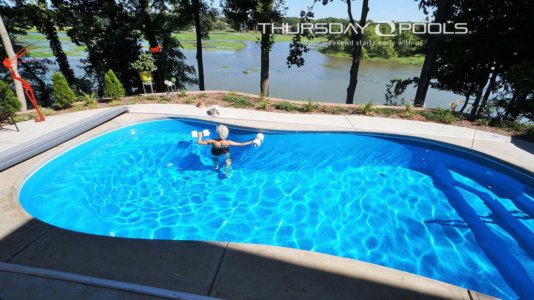
Swimming laps are not the only way you can get a good workout in with your swimming exercise pool. Water aerobics is also an excellent way to build cardio, strength and resistance while being easy on all your joints. Studies have shown that water-based exercises, like water aerobics, relieve pressure placed on joints from arthritis. Water aerobics is a popular option for those who have arthritis. Our Titus pool shell has the ideal depth that is perfect for water aerobics.

exercise poolYou can even add some exercise pool equipment to make your workout more efficient. Foam dumbbells can amplify the muscle-toning effect of moving around in the water. Aqua jogging belts are similar to barbells, and they use the power of buoyancy to intensify your workout. If you want to get fancy, an underwater treadmill is another piece of equipment that you can use to kick up your workout routine. Underwater treadmills are running treadmills that fully submerged under water so you can work on your endurance while feeling resistance from the water. Make sure you are looking for underwater treadmills that are designed for inground swimming pools.
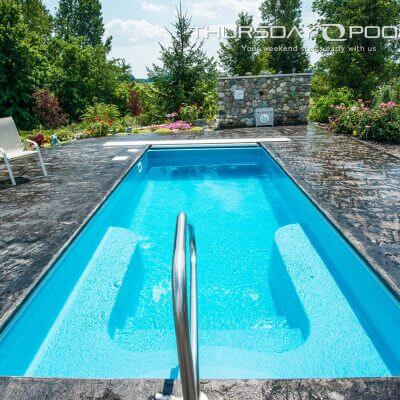
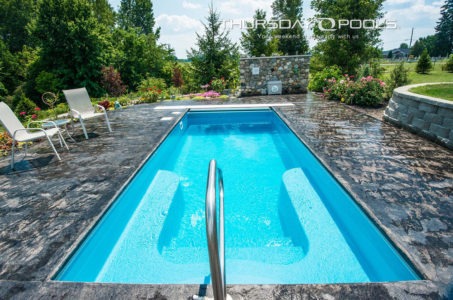
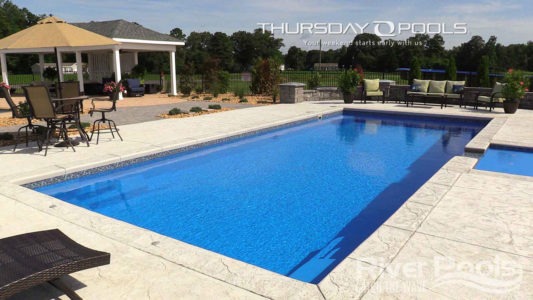
A perfectly designed swimming exercise pool can help you achieve all your fitness goals. At Thursday Pools, we have uniquely designed pool shells that can meet every member of your family’s needs.

How to Pick the Right Thursday Pool for You

Congratulations on choosing to add a fiberglass inground pool to your backyard. You have made a wise investment in yourself and your family. Aside from the obvious health benefits, a swimming pool will bring you countless hours of stress free rest and quality family time. Memories made around a swimming pool last forever. At Thursday Pools we like to say we manufacture memories not just fiberglass pools. We are proud to build memory makers. Now, let’s see if we can help find the right Thursday pool for you to begin making memories.

The first thing you want to start with is size. Small, Medium, or Large? You can determine what size you need by asking yourself 3 basic questions:

  1. What will fit in my backyard? Often setbacks, easements, and other restrictions will play a role in what size pool will work in your backyard.
  2. How many people will be using this pool 90% of the time? And how will they be using it? Exercise, Fun, Relaxing, Lap Swimming??
  3. What is my budget? Fiberglass pool pricing is very much affected by the size of the pool.

Once you have decided what size fiberglass pool fits your needs, you can move on to review the unique style and design features of each pool within that size category. I will review these features and benefits with you starting with our largest pools first. Feel free to skip through to whatever size category is right for you.

Large Rectangle Fiberglass Pools

We have a nice line up of large rectangle fiberglass pools. In this line, you will find the Goliath and Monolith fiberglass pool designs. These designs are perfect for those who like classic clean lines and want a fiberglass pool large enough to swim laps and regularly host their extended family and friends. I cover some great features of these large rectangle fiberglass pool designs below.
Features and Benefits of the Goliath Series designs:

  1. Large shallow end benches provide ample seating but are strategically placed as to not take up a lot of swim area. Benches are set at a depth of 18” from the top of the pool, placing water depth at approximately 12”-14” from the seat.
  2. Deep end benches and swim outs provide a seat on the opposite end of the pool and a swim out for children and our furry family members. It is important to have multiple exit points for children and dogs as they can tire easily while treading water in the deeper end of these pools.
  3. Each pool is outfitted with a courtesy ledge around the deep end edge.
  4. Size and depth can easily accommodate a properly installed slide.
  5. Dual corner entries provide flexibility in the backyard layout and design of your inground pool.
  6. Easily accommodates an automatic cover system.

Features and Benefits of the Monolith fiberglass pool design:

  1. Type 1 Certified Diving Pool. With the correct diving board installation and use, this pool can provide for a safe dive.
  2. The single corner entry provides a large flat bottom shallow end that is ideal for children and a hearty game of basketball. It also provides for a nice lane to swim laps.
  3. The pool’s 15” warning slope separates the shallow end and deep end of the pool. This fiberglass pool should always have a safety line and float on the pool at all times to mark this separation.
  4. This fiberglass pool also has deep-end bench seats and a courtesy ledge that extends around the deep end of the pool.
  5. Easily accommodates an automatic cover system.

Large Free-Form Fiberglass Pools

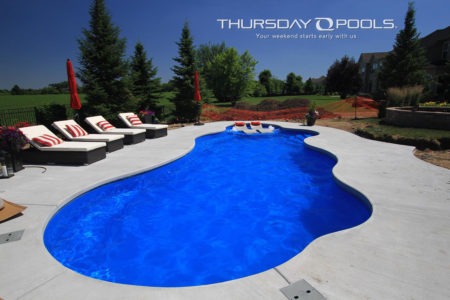
In this category of large free-form fiberglass pools, we have our Wellspring Series.  The Wellspring fiberglass inground pool design is a bountiful source of happiness for the young and old. The large sun shelf and beautifully crafted benches are carefully placed to create an artful display of elegance. This design is perfect for those who picture themselves lounging in luxury while sipping on a beverage and for those who want a cool spot where they can safely watch their toddler splash and play.  Check out these wonderful features and benefits of this inground pool below.
Features and Benefits of the Wellspring Series:

  1. The tanning shelf has a 12” depth leaving water depth at 6”-8”. This spot is perfect for a set of two ledge loungers and bubblers. It is also a perfect depth for toddlers to be able to splash and play in.
  2. The wrap around benches follow the pool’s curves and provide adult seating in strategic places that allow for great conversations and comfort.
  3. Its unique free-form design will grab attention and quickly make it the focal point of your backyard.
  4. Its sheer size enables the pool to still have a large open swim area.

Medium Rectangle Fiberglass Pools

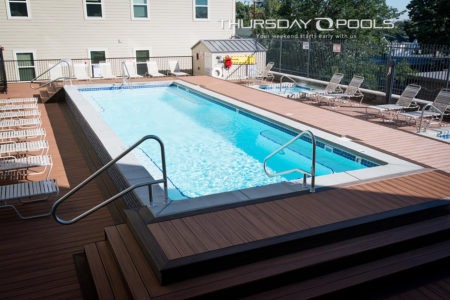
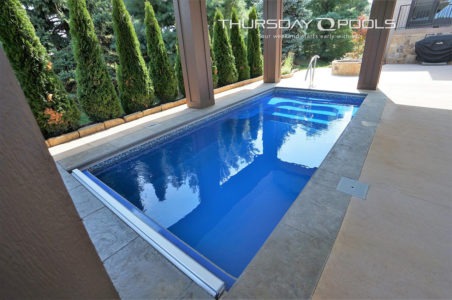
In our lineup of medium sized rectangle fiberglass pools, we have our Lil Bob, Spirit, and Infinity pool designs.  These classy pool designs are perfect for folks who are constrained by space but still want to be able to entertain extended family and friends. These medium sized fiberglass pools can still pack a large pool party punch. Here are some great features that you will love about these three inground pool designs.
Features and Benefits of the Lil Bob, Spirit, and Infinity pool designs:

  1. These 4’6” one-depth flat bottom pools make 100% of the pool usable space. (Very few people hang out in the deep-end of an inground pool and tread water, most always they migrate to the shallow end.) It also makes for a great depth for water sports like volleyball and basketball.
  2. Elongated benches grace both sides of these pools providing plenty of lounging areas for entertaining family and friends. Each bench runs 12’ down the length of the pool.
  3. Easily accommodate an automatic cover system.

Medium Free-form Fiberglass Pools

Are you dreaming of something with a little more pizazz or character to its shape? Try these medium sized free-form fiberglass pools on for size: Titus, Pearl, Cathedral, and Oasis. Because these pools each have their own great design features I will break them out individually and share some of my favorite features of these beautiful inground pools.
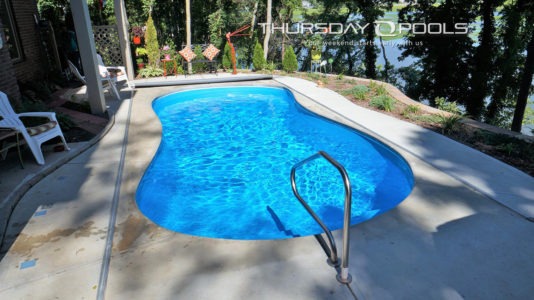
  1. Titus: The Titus is a classic figure eight shape. My favorite feature of this pool is what we refer to as the beverage bench in the deep-end of the pool. If you are looking for an inground pool with a little spunk that you can enjoy with a couple of friends and maybe do a little water aerobics, this may be the right inground pool for you. This pool is available in two sizes.
  2. Pearl: This sea shell shaped jewel is an inground pool design that you won’t find anywhere else. It features the ultimate sun shelf and complete wrap around bench. This pool is perfect for adults looking to relax and unwind.
  3. Cathedral: The roman shape of the Cathedral pool offers a timeless style without sacrificing swim area. The pool features beautiful benches on each end with a large open swim area.
  4. Oasis: The Oasis design provides a less dramatic free-form shape that allows for plenty of open swim area but still delivers a nice cozy corner bench. This design is also available in two sizes.

Small Fiberglass Pools

We have two pools that fall in this category, the Sea Turtle and the small Titus fiberglass pool. If you are looking for a pool for just the two or few of you, these designs are the perfect patio pool and may hit the mark.

  1. The Sea Turtle is a rectangle 10’ x 20’ design. It features a large wrap around bench and flat bottom 4’6” depth. It can easily accommodate a Badu® Swim Jet System and an automatic cover system.
  2. The Titus is a figure eight shaped fiberglass pool that is 12’ x 26’. It features a nice deep-end bench, perfect for the two of you.


Regardless of where you are at in your pool planning process, choosing the right inground pool design for your backyard could become overwhelming. Sometimes having too many choices makes it even more overwhelming. Begin your process by asking and answering the basic questions we mentioned at the beginning. Answering these questions may help eliminate a clear majority of the inground pool designs that you are considering.  Once you have narrowed it down to two or three designs; review the 360 tours and product videos that we have of those pools. Lastly, be sure to consult your Independent Dealer for input, they will be a good resource and chances are they can offer you some feedback that perhaps you hadn’t even considered.


Thursday Pools strongly recommends that diving boards and slides not be installed or used with its pools, given the inherent dangers associated with diving boards and slides in residential pools.  These dangers include brain, spinal cord, and other severe permanent injuries, and death.  For that reason, Thursday Pools® does not manufacture or sell diving boards or slides.  If, despite this warning and recommendation, the owner decides to install or use a diving board or slide, the owner assumes all risks inherent with a diving board or slide, and River Pools® further warns that diving boards and slides require minimum depths and distances and must be installed and used in strict compliance with the equipment manufacturer’s specifications and ANSI/NSPI, ANSI/APSP, and ANSI/APSP/ICC standards, as well as in compliance with all applicable laws, rules, and regulations.  The owner is responsible for making sure the pool is appropriate for diving boards and slides and otherwise meets all standards and laws for diving pools, and the owner must consult the diving board or slide manufacturer and/or installer as to the appropriateness of the pool for the diving board or slide and that its installation, location and use meet all standards and laws for diving and slide pools.

How Fiberglass Pool Delivery Works: Your Pool’s Journey from Factory to Backyard

A fiberglass pool shell arrives at your home in one piece, up to 41 feet long and 16 feet wide, riding on a specialized wide-load trailer. Getting it from the factory to your backyard requires permits, site preparation, access planning, and in some cases, a crane. Here is exactly what that process looks like, from the day your dealer places the order to the day the water goes in.

What Happens Before Your Fiberglass Pool Shell Is Delivered?

Delivery doesn’t start with the truck. It begins with a site visit. Before Thursday Pools ships the shell, your authorized independent dealer visits your property to assess site conditions, confirm access routes for the wide-load trailer and installation equipment, mark utility lines, and verify that excavation can proceed safely.

Fiberglass pool installations also require local building permits in most jurisdictions, and the approval timeline varies by municipality. Your dealer should know the local processes and manage the application on your behalf. Work cannot legally begin until permits have approval, so proactive submission is essential for maintaining desired project timelines.

Once permits are in hand and the site is ready, the dealer coordinates the excavation schedule and the shell shipment. 

How Does a Fiberglass Pool Shell Get Transported to Your Home?

Thursday Pools manufactures fiberglass pool shells at our facility in Fortville, Indiana. Each completed shell loads onto a flatbed trailer permitted for wide loads and travels to the customer’s property, sometimes hundreds of miles away. Wide-load transport follows state and local routing rules that restrict which roads a vehicle of that size can use. 

What Happens When the Route Gets Complicated?

Most deliveries make it to their destination without incident. Some require an innovative approach to get there. One delivery to a home on Geist Reservoir near Indianapolis required something entirely unique. The homeowner’s street couldn’t accommodate a wide-load truck, so their local Thursday Pools dealer coordinated with Geist Marina personnel to lower the buoyant pool shell into the water and tow it across the reservoir to the customer’s backyard.


That story isn’t an outlier as much as it is an illustration of what delivery logistics actually require. Tight alleys, narrow gates, dense suburban streets, overhead utility lines, and sloped driveways all present real access challenges. Your dealer will assess these conditions during pre-delivery site visits and plan accordingly, whether that means alternative rigging, crane placement, or phasing access differently.

What Happens When the Shell Arrives? How Is the Pool Set?

Once the shell arrives, the installation crew uses a crane or specialized equipment to lift it from the trailer and place it in the excavated hole.

With the shell on its gravel base, the crew begins the simultaneous backfill and fill process. Backfilling material goes in around the outside of the shell at the same rate water goes inside, with the equalizing pressure preventing the fiberglass walls from bowing or deforming under soil load. The shell-setting phase typically takes one to two days for a standard residential installation, depending on site conditions and pool size.

What Does Fiberglass Pool Installation Include After the Shell Is Set?

Pool delivery and placing the shell in the ground are parts of a longer process. After the shell is set and backfilled, installers connect plumbing and electrical systems, complete a local inspection, install coping and decking, and balance the water chemistry before the pool is ready to use.

A complete fiberglass pool installation project typically takes two to four weeks, depending on site conditions, permit inspection scheduling, and the scope of surrounding decking and landscaping. For a detailed walkthrough of every phase, see our complete Fiberglass Pool Installation Guide.

What Affects the Pool Delivery and Installation Timeline?

Several factors influence how long the full process takes from order to water:

Permit Approval Speed: Some municipalities approve pool permits in a week. Others take four to six weeks or longer, particularly in jurisdictions with backlogged building departments or additional HOA review requirements.

Site Conditions: Rocky soil, high water tables, limited access, or significant grade changes all extend the excavation and installation timeline. 

Weather: Heavy sustained rainfall can delay excavation, backfill, and concrete work. Most installers can work through light rain, but saturated ground requires a pause until conditions stabilize.

Decking and Landscaping Scope: The pool itself installs quickly. A large custom patio, retaining walls, or extensive landscaping can extend the overall project timeline independent of how smoothly the shell installation goes.

Talk to a Local Thursday Pools Dealer

Pool delivery and installation details vary by site and geographic location. A yard that looks straightforward may have a buried utility, HOA setback restrictions, or access restrictions that change the logistics.

The best way to understand exactly what delivery looks like for your specific property is to talk with an authorized Thursday Pools independent dealer in your area. They will assess your yard, walk you through the delivery and installation sequence, review design options, and give you an accurate project estimate based on your site.

Frequently Asked Questions About Fiberglass Pool Delivery

How is a fiberglass pool delivered to my home?

Your fiberglass pool shell travels from Thursday Pools’ manufacturing facility on a specialized flatbed trailer permitted for wide loads. The trailer delivers the shell to your property, where a crane or rigging equipment lifts it off the truck and into the excavated hole. Your local independent Thursday Pools dealer coordinates the route, timing, and access logistics for each delivery.

How big is a fiberglass pool shell for transport?

Thursday Pools fiberglass pool shells are up to 16 feet wide, the practical limit set by wide-load transport regulations, and up to 41 feet long. The shell ships as a single one-piece unit, which is why transportation dimensions set the upper size limit for fiberglass pools. A pool that large requires a wide-load trailer permit and, in some states, requires the truck to follow specific state-approved routes.

What if my yard doesn’t have enough access for pool delivery?

Limited yard access is one of the most common delivery complications, but it rarely prevents the project from moving forward. Your dealer will assess access during the initial site visit. Solutions include using smaller specialized equipment, adjusting the trailer approach angle, or bringing in a crane with a longer reach to clear an obstacle. In unusual cases, installers map an alternative delivery method before the truck leaves the factory.

What permits are needed before a fiberglass pool can be delivered?

Most jurisdictions require a building permit before pool excavation or installation can begin, and separate electrical and plumbing permit may also apply. Your dealer will help with managing the permit application and knows the local requirements. Permit approval timelines vary significantly by location, from one week to six weeks or more in some municipalities. Scheduling by early spring helps avoid delays that push delivery deep into summer.

How long does fiberglass pool delivery and installation take in total?

The shell-setting phase typically takes one to two days, while the full installation from excavation through final water balancing usually runs two to four weeks. Site conditions, local inspection scheduling, and the scope of surrounding decking and landscaping all affect where the project lands within that range.

Does the homeowner need to be present during pool delivery?

While your presence is not legally or logistically required for the installation crew to proceed, most homeowners choose to be present for the delivery. Your dealer will advise you on this. The delivery and shell-setting process is one of the more visually dramatic stages of a pool project. That said, your dealer will fully manage the crew and the logistics.

What is a wide-load trailer, and why does fiberglass pool delivery need one?

A wide-load trailer is a specialized flatbed permitted to carry cargo exceeding standard highway width limits (typically 8.5 feet), which is necessary for one-piece fiberglass shells. Because fiberglass pool shells can reach 16 feet in width and 41 feet in length, standard trailers can’t carry them legally or safely. Wide-load transport requires special permits, sometimes requires escort vehicles, and follows routes that accommodate the oversize dimensions.

The Goliath Fiberglass Pool Design

Your family just called, and you’ve been summoned. For what, you wonder? Other than working harder than usual and needing a vacation, nothing major has happened that would require you to immediately return home. But, wait. There is something, and it’s big – as in gigantic, and it’s guaranteed to make everyone happy. Best of all, it’s calling your name.

So you leave work and head home where you’re immediately greeted by your kids who have finally convinced you that it’s time to invest in a fiberglass pool, and the Goliath from Thursday Pools is what they’ve been seeking. Just as you’re being whisked away in thoughts of your own backyard paradise, questions start swirling inside your head.  Why this fiberglass pool over another? How much does it cost and how long will it take for installation? What are the benefits of this pool?

As your mind wanders and your heart races, you suddenly stop and say something to the effect of, “Now, kids. I want this as much as you do, but before we jump in too deep, we need to learn a little more.”

Although feeling defeated, they reluctantly agree.

Because we realize that there’s a delicate balance between pleasing your family and knowing you’ve made the right decision, we offer this blog post about the Goliath in hopes that it reassures you and the decision you’re making to invest in one of our most popular pools.

What is the Goliath?

The Thursday Pools’ Goliath series are large rectangular, fiberglass pool shells with one gradual expanse. Sizes will vary by length, but with three different options to choose from, there’s sure to be a size perfect for your backyard.

Why this pool over another?

Thursday Pools offers many sizes and types of fiberglass pools, but if size is important, you won’t regret investing in the Goliath. This open design provides plenty of swim area, a center swim lane and corner benches for lounging.  Add in that every Thursday Pool is designed with master craftsmanship and you can feel good about the investment. What’s more, by promoting efficient use of raw materials, all Thursday Pools will leave a small environmental footprint.

How much does a 16’ x 41’ Fiberglass Pool cost?

Although it’s difficult to provide an exact timeline and quote without seeing the installation site and factoring in specific equipment and accessories, it’s a good idea to consider the fiberglass pool length, and to figure that every foot will cost approximately $1,800. For instance, the Goliath fiberglass pool shell design of 16’ x 41’ will be around $73,800 for a basic installation package. Maintenance costs will also vary, but it’s important to know that upkeep and chemicals for a fiberglass pool are far less than the cost of maintaining and owning a concrete or vinyl pool. In the end, if saving money is important, a fiberglass pool is the right decision.

What are the Goliath features and benefits?

Beyond its size, craftsmanship, and eco-friendliness, the Thursday Pools Goliath fiberglass pool shell is made with advanced technologies and multiple layers of strength. The Goliath also features dual corner entry steps that accommodate most backyards, and the design easily accommodates an automatic safety cover. The elongated benches make for a great adult gathering spot without taking up too much swim space. The open center lane allows for the recreational swimmer to swim laps. The deep-end swim-outs and bench seats provide an alternate entry and exit point, perfect for younger children or your furry and four-legged family members.

The Thursday Pools Goliath fiberglass pool is a true mark of beauty, and with its added functionality, it will provide you and your family with many years of fun and happiness in your own backyard paradise. For more information about the Goliath fiberglass pool, or to learn more about Thursday Pools, find a local dealer today.

POLYCOR® Shimmer® gel coat proves to be the ideal surface for inground swimming pools.

Daydreaming of that quick dip in the pool? Making that dream into a reality has now been made even easier by the folks at Thursday Pools®! Combining 26 years of experience in fiberglass pools and spa design with manufacturing across multiple industries, Thursday Pools® edge innovations to the pool world. Thursday Pools® builds some of the highest quality fiberglass pools in the industry, all starting with the finest grade of gel coat available for pool producers: CCP’s Shimmer® gel coats. With a coatings history that dates back to 1913 (then known as Cook Paint and Varnish) and later as the first gel coat producer in the late 1950’s, CCP Composites has produced market inspired gel coats for some of the most demanding applications and industries, including:

  • Marine boat hulls and decks where constant impact, toughness, UV, blister and water protection are demanded
  • Gel coats for tub shower units, where moisture resistance, impact, and cleaning chemicals are used
  • Fatigue and moisture resistance for wind energy blades
  • Truck hoods, air deflectors and sidewall panels where moisture, impact, fatigue, UV and heat all come into play

CCP Composites aggressively researches market needs and expectations, offering only the finest materials that will stand up to demanding industry needs. With pools in particular, only certain colors like white and light blue gel coats were suggested to s, mainly due to the nature of the chemicals needed to keep pool water healthy. These included adding acids or caustic materials to adjust pool pH, certain metallic salts chlorinated chemicals to control bacterial of the gel coat surface, either through mineral deposits or bleaching of the surface through chlorine attack.

Fabrication of a Thursday Pool starts with Shimmer®

Surprisingly, ambient temperature,chemically‐treated pool water is more aggressive chemically than salt water from the ocean. The lack of color options is often cited as one of the main reasons for choosing cement/tiled finished in‐ground pools over the superior performance of fiberglass reinforced plastic (FRP) pools.

Vinyl lined pools were also more popular because beyond the  increased color range, vinyl pools offer a smooth floor (unlike the bottom of cement pools, which have a tendency to cut up customer‘s feet as they walked or played in the pool). All that changed in 2002, when one of the first pools was fabricated with a break‐through, deep colored gel coat specifically formulated by CCP’s sister company, CCP Composites Australia (FKA Cray Valley) for the rapidly growing pool industry in Australia. This product was heavily researched for blister, water uptake, color fade (bleaching) and for UV resistance. This new, ISO/NPG high performance gel coat proved to be far superior in all respects when compared to conventional pool gel coat products available at the time. Within 3‐4 years of product launch, the CCP Composites gel coat, known as POLYCOR® Shimmer®, became the dominant pool gel coat used in Australia. CCP Composites US brought this gel coat technology to the North American market, where it is now rapidly becoming the pool industry’s “go to” gel coat. Several years ago, Thursday Pools® found the benefits of Shimmer® for their pools, just as the Australian pool manufacturers did in 2002.

Bill Khamis, CFO of Thursday Pools, has seen immediate benefits of the Shimmer® products, such as “reduced air pressure for reduced styrene emissions,” along with “better transfer efficiencies that have resulted in a 30% savings in gel coat materials consumed.” “25% labor savings” have also been utilized in that it “takes less time to spray a mold, cleans up faster and spray gun set up is significantly faster.” Improved lay down of the gel coat has also been noted in a “better and more uniform surface quality that customers have noticed.” Bill is a very strong advocate for the Shimmer® product, sharing that customers not only love the color range, but also the depth of color, made even greater by the glittering particles included in the Shimmer® products.

In addition to color range and the advantages of fiberglass pools over concrete, Thursday Pools require 70% less chemicals usage, have cleaner surfaces and reduced maintenance that are significantly less abrasive to the skin and feet, and are far less prone to cracking. The only advantage to vinyl linings is the lower initial installed cost; however, ongoing maintenance costs increase every time the liner tears as it must be repaired or replaced. As you can see, FRP pools are clearly the way to go. With over 5 million in ground pools installed in the US (and over 53,000 installed in 2012 alone) and 5 of the top 10 pool states (Source: APSP 2013) within driving distance of their central Indiana location, Thursday Pools is well located, well suited and well-organized to capitalize on the growth potential of the Midwest FRP pool market.

Ed Vondell, COO of Thursday Pools®, noted the valued technical and product support that CCP Composites has provided with Bill Bannow, Technical Services Engineer and Jason Baranowski, Account Manager. Both have spent long hours in specialized support staff training in the use of the Shimmer® products, and more recently, introducing the CCP Composites rapid mold manufacturing technology that utilizes the OptiPLUS® mold making materials for a brand new Thursday Pools® design launching in 2014. The outlook for Thursday Pools® and Shimmer® gel coat looks quite promising in 2014 and beyond.

The Evolution of Fiberglass – Thursday Pools, from Auto and Marine Fiberglass Parts to Awesome Fiberglass Swimming Pools

Fiberglass Pool History

The creation of Facebook, Apple and Windows are well-known business success stories which garnered unprecedented media coverage, captivating the general public worldwide. Some of the Internet companies seem to have been created overnight, attracting job seekers and Wall Street investors to the glamor and fame of high-tech companies. Thursday Pools on the other hand started over thirty years ago in the garage of Bill Khamis, founder of the company. The company wasn’t incorporated thirty years ago but the foundation, technical know how and expertise was born in Khamis’ garage in Indianapolis, Indiana.

fiberglass pool history
Bill Khamis, Co-Owner of Thursday Pools, LLC

Khamis started learning and making race car parts out of fiberglass for a local race car company while he was still in high school. To make the specialized parts he teamed up with resin and fiberglass suppliers to learn tool making and production techniques. The tooling he developed was much smaller than Thursday Pools pool molds but met the high standards of the auto and race car industry.

After graduating from high school and during college Khamis was asked to make bigger parts and diversify from auto parts. He founded a new company called Fabri-Tech with a high school friend, Dave Camp, and started building huge fiberglass outdoor scenes for the family entertainment centers, zoos and parks. This was his stepping stone for building large molds and parts.

After selling Fabri-Tech he moved into the marine industry and built molds for his new company, KamKraft Boats. The precision molds he built using steel substructure and part tolerances, unknown in the pool industry, were a precursor for things to come. If boat building wasn’t enough, Khamis teamed up and started making carbon fiber parts for auto and the precision measuring machine industry. The parts Khamis made out of carbon fiber had even more exact tolerances which again honed Khamis’ tool making skills. Not only did it improve his tool making skills; it also gave him hands on experience with laminate schedules and materials needed for different applications.

In parallel, Khamis began high-end custom home building along with gunite pool building. He remembers the early days when gunite was 90% of the market for the high-end, million dollar plus homes. Over the years the homeowners started requesting fiberglass swimming pools so he started hiring contractors to do the installs. During this time he compared the installation time and effort of gunite versus fiberglass. He was amazed when a fiberglass pool was installed and complete in only a few short days versus the weeks his gunite crews worked on the pools.

Fast forward to 2010 and the birth of Thursday Pools. Khamis purchased an inground fiberglass pool and when it was installed, he was seriously disappointed in the quality. However, he didn’t send the pool back to the manufacturer and ask for his money back. Instead, he decided he could do better and that’s how Thursday Pools came to be.