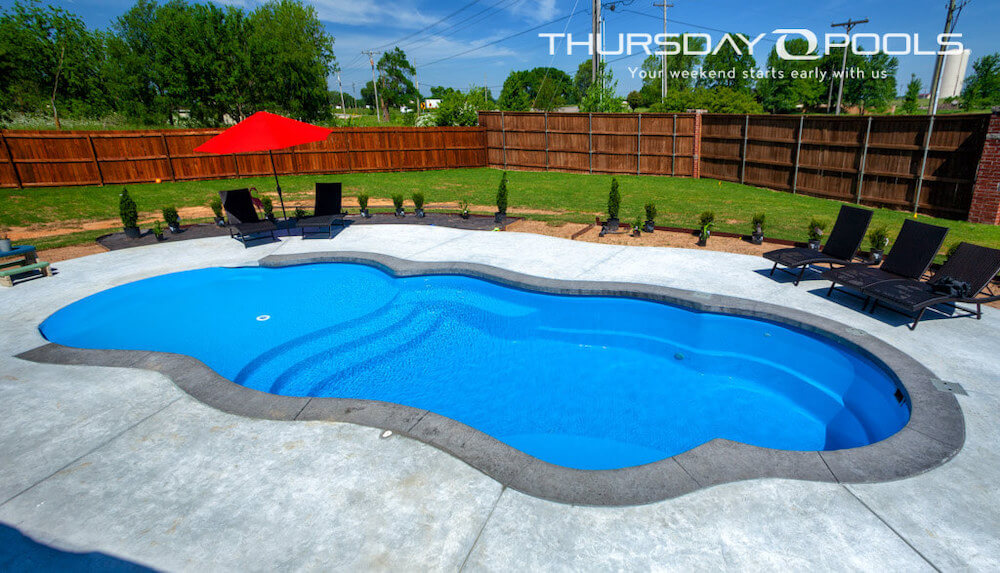
Most people shopping for a fiberglass pool already know they want one. The harder question is what size actually fits your yard, your family, and the way you plan to use the pool. The range is wider than most people expect, from compact plunge pool models and small fiberglass pools to full-size 16′ x 41′ designs with room for lap swimming and a crowd. Choosing the right size starts with three factors: available yard space, how many people will use the pool, and whether you want it for lounging, play, exercise, or entertaining.
Why Fiberglass Pool Width Stops at 16 Feet
Before getting into specific sizes, there is one constraint that shapes the entire fiberglass pool industry: width.
Fiberglass pools ship as one-piece shells. This construction method supports faster installation, eliminates liner seams, and creates a strong one-piece shell, but it also means the pool must travel by road to reach your backyard. Most states set an oversized load limit of 16 feet, capping fiberglass pool width for every manufacturer. If your plans call for a pool wider than 16 feet, a custom concrete or vinyl liner build is the path to get there. For most residential backyards, 16 feet of pool width is more than enough to enjoy with a large family, and while entertaining guests.
Small Fiberglass Pool Sizes: Plunge Pools and Compact Designs
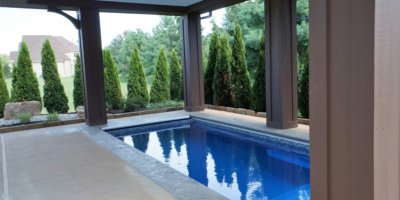
Small fiberglass pools generally fall under 400 square feet. Plunge pools, sometimes called cocktail pools or spools, occupy the smallest end of this range, typically 8 to 12 feet wide and 16 to 26 feet long.
These pools work well when yard space is limited, when you want the pool to complement your outdoor living area rather than dominate it, or when a smaller footprint makes more financial sense. The Thursday Pools Plunge Pool Series is built specifically for this range. Small fiberglass pools are best for homeowners who want cooling, lounging, or light exercise more than open swim space.
| Pool Model |
Dimension |
Depth |
Square Feet |
| The Drift |
8’4″ x 16′ |
4’8″ flat bottom |
134 |
| The Nest |
8’4″ x 16′ |
4’8″ flat bottom |
134 |
| The Nook |
8’4″ x 16′ |
4’8″ flat bottom |
134 |
| Sea Turtle |
9.5′ x 19.5′ |
4’6″ flat bottom |
185 |
| Titus |
12′ x 26′ |
5’5″ |
300 |
| Aspen |
12′ x 25′ |
5’1″ |
300 |
| Goliath |
12′ x 25′ |
5’4″ |
300 |
The Nest, The Nook, and The Drift share the same 8’4″ x 16′ footprint and 4’8″ flat-bottom depth, but each uses the space differently. The Drift has a full-length wraparound bench for lounging. The Nook uses bench seating on both sides. The Nest keeps a more open swim area with full-width entry steps. Sea Turtle steps up to 9.5′ x 19.5′ at 4’6″ flat-bottom depth and has a swim-jet-ready design for light exercise.
Medium Fiberglass Pool Sizes: The Most Popular Range for Families
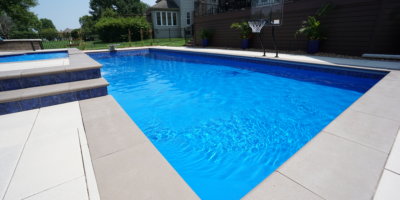
Medium-size fiberglass pools, roughly 13 to 16 feet wide and 28 to 37 feet long, give most families the balance they need. There is enough length for laps and active play, enough width to move around comfortably, and room for the kids without the pool consuming the entire backyard.
This is also where the widest variety of design options lives, from sport-depth flat-bottom pools to models with tanning ledges, integrated spas, and beach entries.
| Pool Model |
Dimension |
Depth |
Square Feet |
| Pearl |
15’ x 25’ |
3’9” |
375 |
| Lil Bob |
13.5′ x 27.5′ |
4’6″ flat bottom |
371 |
| Lil Bob LX |
13.5′ x 35.5′ |
4’6″ flat bottom |
479 |
| Spirit |
13.5’ x 40’ |
4’6″ flat bottom |
540 |
| Cathedral |
14’ x 33’ |
5′ |
462 |
| Titus |
14’ x 33’ |
5’10” |
462 |
| Sun Day |
15′ x 30′ |
5’4″ |
450 |
| Aspen |
14′ x 30′ / 14′ x 35′ / 16′ x 35′ |
5’5″ |
420 – 560 |
| Goliath |
14′ x 29′ / 14′ x 33′ / 16′ x 33′ |
5’8″ – 6′ |
406 – 592 |
| Grace Beach Entry |
14′ x 36′ |
5’6″ |
504 |
Large Fiberglass Pool Sizes: Maximum Room to Swim and Gather
Large fiberglass pools start around 16′ x 39′ and top out at 16′ x 41′. At this scale, the pool becomes the primary focus of the backyard. The design, depth, and feature set matter as much as the footprint. Large models make the most sense when the pool will be used for frequent entertaining, active swimming, or as the main feature of the outdoor space.
| Pool Model |
Dimension |
Depth |
Square Feet |
| Mack Daddy |
16′ x 36′ |
4’8″ flat bottom |
576 |
| Magnate |
16′ x 36′ |
4’8″ flat bottom |
576 |
| Grace Beach Entry |
16′ x 36′ / 16′ x 40′ |
5’6″ – 5’10” |
576 – 640 |
| Wellspring |
16’ x 36’ / 16′ x 40′ |
5’10” |
576 – 640 |
| Cathedral LX |
16’ x 36’ / 16′ x 40′ |
5’8” – 6′ |
576 – 640 |
| Aspen |
16′ x 35′ / 16’ x 40’ |
5’5″ – 5’10” |
560 – 640 |
| Big Bob |
16′ x 40′ |
4’6” flat bottom |
640 |
| Monolith |
16′ x 40′ |
8’6″ |
640 |
| Sandal Beach Entry |
16′ x 34.5′ / 16′ x 39′ |
5’8” – 6′ |
552 – 624 |
| Sun Day |
16′ x 34.5′ / 16′ x 39′ |
5’8” – 6′ |
552 – 624 |
| Goliath |
16′ x 37′ / 16′ x 41′ |
6’4” – 6’8″ |
592 – 656 |
At this scale, Big Bob is a 16’ x 40’ rectangle offering a uniform 4’6” flat-bottom depth throughout. It’s the largest pool in the Bob family, built for homeowners who want maximum bench seating, a wide-open swim and play area, and room to comfortably host a crowd. Monolith is at the opposite end of the depth range, with an 8’6″ deep end that makes it the only Type 1 diving pool in Thursday Pools’ lineup.
How to Choose the Right Fiberglass Pool Size for Your Backyard
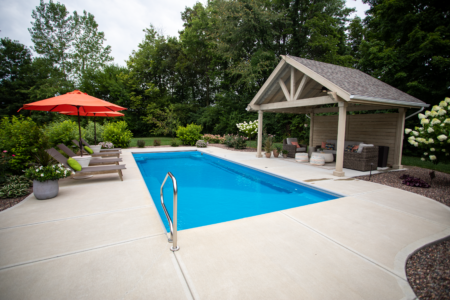
Size on paper and size in your yard are different things. A 16′ x 40′ pool can be exactly right for a spacious lot and feel overwhelming in a modest suburban backyard. A few practical factors to weigh before committing:
Yard dimensions and required setbacks: The pool needs clearance from property lines, fences, utilities, and structures. A local dealer can evaluate your specific lot before you choose a model.
How you plan to use it: A family of four that swims laps and plays water basketball needs a different pool than a couple looking for an evening plunge. Intended use matters more than square footage.
Budget, including long-term operating costs: Longer pools cost more to install and maintain. A larger water volume takes more energy to heat and more chemicals to balance. Factor those ongoing costs into the size decision, not just the installation price.
Space for everything else: The pool is one part of the backyard. Consider how much room you want for decking, seating, landscaping, and lawn before settling on a size.
Try out the Thursday Pools Pool Selector Tool to compare models by yard size, preferred features, and planned use.
Ready to Find the Right Size?
The right pool size depends on how you will use it, what your yard can accommodate, and what your budget supports. A local Thursday Pools independent dealer can evaluate your property, confirm available models, and provide an installation estimate for your site.
Frequently Asked Questions About Fiberglass Pool Sizes
What is the most common fiberglass pool size?
Many residential fiberglass pools fall in the 13- to 16-foot-wide by 30- to 40-foot-long range because that size balances swim space, yard impact, and budget. Most families find that range strikes the right balance of swim space, yard impact, and budget. Plunge pool models in the 8′ x 16′ to 12′ x 26′ range have grown in popularity as homeowners prioritize lower-maintenance options and want to preserve outdoor living space beyond the pool itself.
What is the maximum size for a fiberglass pool?
Most fiberglass pools max out at 16 feet wide and 41 feet long. The 16-foot width limit comes from highway transportation regulations. Fiberglass pools ship as one-piece shells, and most states set 16 feet as the oversize load limit for road transport.
What is the smallest fiberglass pool size available?
The smallest fiberglass pools typically start around 8 to 10 feet wide and 14 to 16 feet long. Thursday Pools’ smallest models, including The Nest, The Nook, and The Drift, all measure 8’4″ x 16′ with a 4’8″ flat-bottom depth. These compact designs fit smaller backyards, courtyard spaces, and lots where a full-size pool is not practical.
How wide can a fiberglass pool be?
The practical maximum is 16 feet wide for a fiberglass pool. Because fiberglass pools ship as single-piece shells, they are subject to highway transportation width limits, which most states set at 16 feet.
What size fiberglass pool is best for a family of four?
For a typical family of four with kids, a pool in the 13.5′ x 35′ to 16′ x 40′ range tends to work well, with enough open swim area for games and laps while still fitting most residential lots. Flat-bottom models at 4’6″ depth, like the Lil Bob LX, Spirit, or Big Bob, are well-suited for families with younger children because swimmers can touch the bottom anywhere in the pool. For smaller yards or families who prioritize lounging over active swimming, a compact model like the Sea Turtle or Lil Bob can be a better fit.
Does pool size affect cost?
Yes, significantly. Longer and wider pools require more excavation, more backfill, more decking, and larger volumes of water to fill and maintain. As a general benchmark, plan on roughly $1,800 per foot of pool length for an installed fiberglass pool, though that figure varies based on location, site conditions, and the features added. A 16′ x 40′ pool will cost more to install and operate than a 12′ x 25′ model, both upfront and in ongoing heating, chemical, and water costs. A local dealer can give the most accurate estimate.
Can a fiberglass pool be too big for a backyard?
A pool can overpower a yard if the size does not match the available space and how the rest of the lot will be used. Beyond the pool shell, you need room for decking or patio, required setbacks from property lines and structures, and ideally some remaining yard for landscaping or outdoor living. A local Thursday Pools dealer can evaluate your property and recommend sizes that work within your specific lot.
What is a plunge pool, and how does it differ from a standard fiberglass pool?
A plunge pool is a smaller, shallower pool designed primarily for cooling off, relaxing, and light social use rather than lap swimming or active recreation. Plunge pools typically range from 8 to 12 feet wide and 14 to 26 feet long with flat-bottom depths around 4’6″ to 5’5″. They cost less to install and maintain than full-size pools and work well in smaller yards or as a complement to an existing outdoor living space.
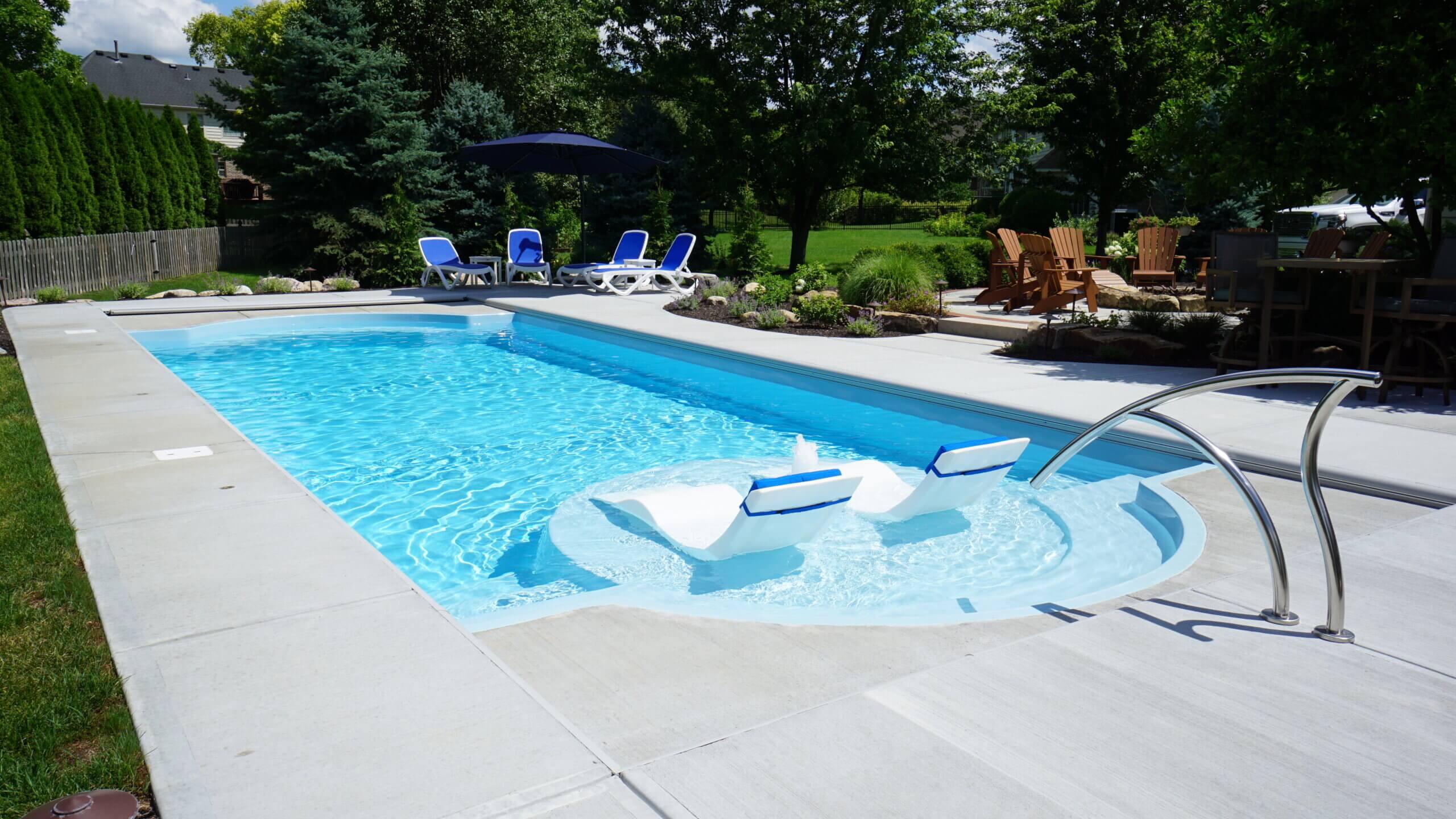
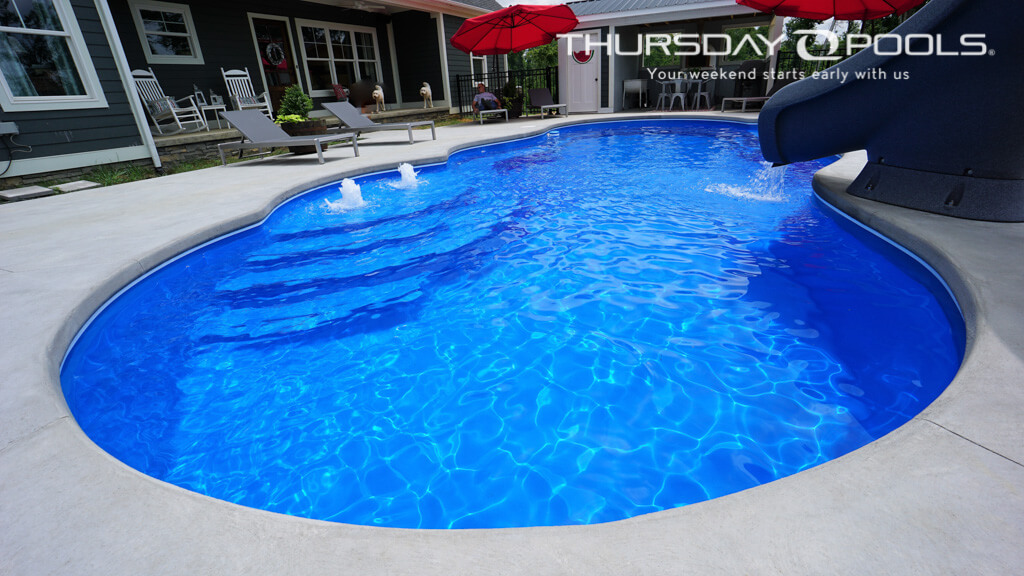


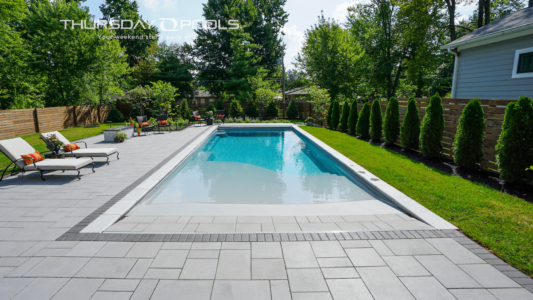 all ages (and pets). The gentle slope lets you stay cool in the water while soaking up the sun, and it provides a great place for little ones to splash around in the shallow waters.
 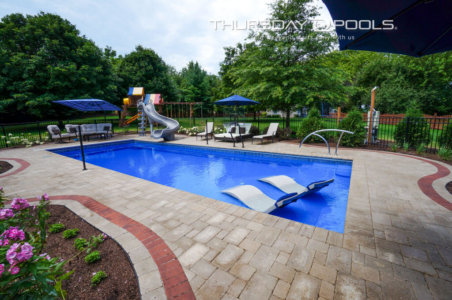 A best-seller, the
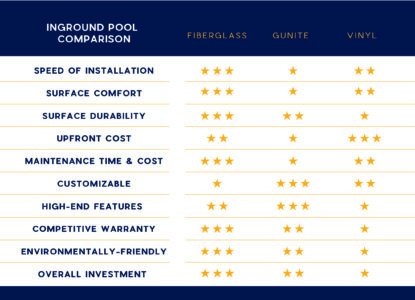
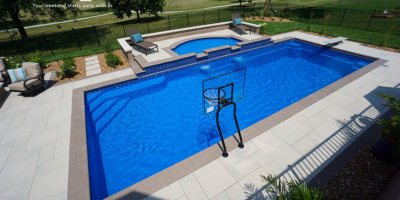 If you are considering an inground pool, you will quickly realize that much information is available. You will likely first consider what type of pool is right for you as you compare the three different inground pool types. Looking for the pros and cons of fiberglass pools vs. concrete or vinyl liners can help you narrow down your preferred pool type. If you’ve already narrowed it down to fiberglass pools, you may even have Googled, “What is the downside to fiberglass pools?” or “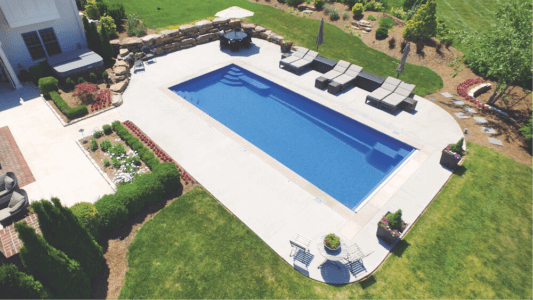
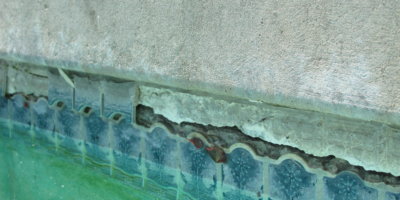
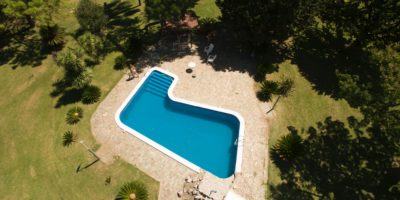 Concrete pools allow for customization and creativity. They offer the most flexibility of all pools, allowing the buyer to choose the look, feel, shape, depth, size, and features. The concrete pool surface is typically rough, and as a result, can snag swimsuits and scrape kids’ feet and dogs’ paws. The cost can be higher, ranging from $50,000 to $120,000 and up. Concrete pool costs vary broadly based on customizations and region of the country.
 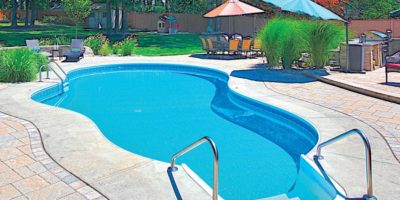 steel brush on its more delicate surface. Your level of care will depend in part on how much you use it and how proactive you are with regular maintenance. Its propensity to rip can result in the need for patching and or liner replacements. Liner replacements can be a $3,000 to $7,500 investment every five to seven years. If water chemistry isn’t carefully maintained, the liner may need to be replaced more often. The seams of a vinyl pool can also collect algae, keeping your regular chemistry costs about double to fiberglass. With a vinyl pool, you can save a little money by filtering one time per day and using fewer chemicals than you would with concrete, and you may not need to hire a professional as often as you might with a concrete pool.
 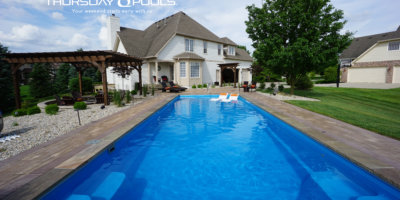 Fiberglass today provides the best of both worlds. Like a vinyl pool, it is quick to install—quicker in that it comes as an entirely manufactured shell ready to be dropped into an excavated backyard spot. While not as customizable as concrete pools,